

Updated N10-009 Dumps Questions Are Available [2026] For Passing CompTIA Exam
Free UPDATED CompTIA N10-009 Certification Exam Dumps is Online
CompTIA N10-009 Exam Syllabus Topics:
| Topic | Details |
|---|---|
| Topic 1 |
|
| Topic 2 |
|
| Topic 3 |
|
| Topic 4 |
|
| Topic 5 |
|
NEW QUESTION # 136
SIMULATION
You have been tasked with setting up a wireless network in an office. The network will consist of 3 Access Points and a single switch. The network must meet the following parameters:
The SSIDs need to be configured as CorpNet with a key of S3cr3t!
The wireless signals should not interfere with each other
The subnet the Access Points and switch are on should only support 30 devices maximum The Access Points should be configured to only support TKIP clients at a maximum speed INSTRUCTONS Click on the wireless devices and review their information and adjust the settings of the access points to meet the given requirements.
If at any time you would like to bring back the initial state of the simulation, please click the Reset All button.


Answer:
Explanation:
See explanation below.
Explanation:
On the first exhibit, the layout should be as follows


Exhibit 2 as follows
Access Point Name AP2

Exhibit 3 as follows
Access Point Name AP3

NEW QUESTION # 137
A customer is adding fiber connectivity between adjacent buildings. A technician terminates the multimode cable to the fiber patch panel. After the technician connects the fiber patch cable, the indicator light does not turn on. Which of the following should a technician try first to troubleshoot this issue?
- A. Verify the fiber size.
- B. Reverse the fibers.
- C. Examine the cable runs for visual faults.
- D. Reterminate the fibers.
Answer: B
Explanation:
When working with fiber optic cables, one common issue is that the transmit (TX) and receive (RX) fibers might be reversed. The first step in troubleshooting should be to reverse the fibers at one end to ensure they are correctly aligned (TX to RX and RX to TX). This is a simple and quick step to rule out a common issue before moving on to more complex troubleshooting.
NEW QUESTION # 138
Users are reporting issues with mobile phone connectivity after a cellular repeater was recently installed. Users also note that the phones are rapidly losing battery charge. Which of the following should the technician check first to troubleshoot the issue?
- A. Channel frequency
- B. WPS configuration
- C. Signal strength
- D. Power budget
Answer: C
Explanation:
When signal strength is poor, mobile devices constantly boost their transmission power in an attempt to maintain a stable connection. This results in dropped calls/data and rapid battery drain. Since a repeater was installed, misalignment or misconfiguration could be degrading the signal strength.
A . WPS applies to Wi-Fi, not cellular repeaters.
C . Channel frequency might matter for interference, but signal strength is the most direct cause of the described symptoms.
D . Power budget applies to PoE and wired devices, not mobile phones.
Reference (CompTIA Network+ N10-009):
NEW QUESTION # 139
Which of the following network attacks causes a switch to flood all frames out of all ports by overflowing its CAM table?
- A. ARP poisoning
- B. MAC flooding
- C. Evil twin
- D. DNS spoofing
Answer: B
Explanation:
MAC flooding overwhelms a switch's CAM (Content Addressable Memory) table by sending a flood of frames with spoofed MAC addresses. Once the CAM table overflows, the switch cannot learn legitimate MAC addresses and defaults to flooding all frames out all ports, effectively turning it into a hub. This allows an attacker to capture traffic not originally destined for their port.
* A. ARP poisoning corrupts ARP tables to redirect traffic but does not overflow the CAM table.
* B. Evil twin is a wireless rogue AP attack, unrelated to switch behavior.
* D. DNS spoofing redirects domain queries, not Layer 2 switching.
References (CompTIA Network+ N10-009):
* Domain: Network Security - Switch security, CAM table attacks, MAC flooding.
NEW QUESTION # 140
Which of the following ports is used for secure email?
- A. 0
- B. 1
- C. 2
- D. 3
Answer: B
Explanation:
Port 587 is used for secure email submission. This port is designated for message submission by mail clients to mail servers using the SMTP protocol, typically with STARTTLS for encryption.
Port 25: Traditionally used for SMTP relay, but not secure and often blocked by ISPs for outgoing mail due to spam concerns.
Port 110: Used for POP3 (Post Office Protocol version 3), not typically secured.
Port 143: Used for IMAP (Internet Message Access Protocol), which can be secured with STARTTLS or SSL
/TLS.
Port 587: Specifically used for authenticated email submission (SMTP) with encryption, ensuring secure transmission of email from clients to servers.
Network References:
CompTIA Network+ N10-007 Official Certification Guide: Discusses email protocols and ports, including secure email transmission.
Cisco Networking Academy: Provides training on securing email communications and the use of appropriate ports.
Network+ Certification All-in-One Exam Guide: Explains email protocols, ports, and security considerations for email transmission.
NEW QUESTION # 141
Users are unable to access files on their department share located on flle_server 2. The network administrator has been tasked with validating routing between networks hosting workstation A and file server 2.
INSTRUCTIONS
Click on each router to review output, identity any Issues, and configure the appropriate solution If at any time you would like to bring back the initial state of trie simulation, please click the reset All button;

Answer:
Explanation:
See the solution configuration below in Explanation.
Explanation:


NEW QUESTION # 142
Which of the following allows a user to connect to an isolated device on a stand-alone network?
- A. Clientless VPN
- B. Secure Shell (SSH)
- C. API gateway
- D. Jump box
Answer: D
Explanation:
A jump box is a hardened system that provides secure access to isolated or sensitive devices on a separate network.
Breakdown of Options:
A: Jump box - # Correct answer. Acts as a middle point for secure remote access.
B: API gateway - Used for managing API calls, not remote access to isolated devices.
C: Secure Shell (SSH) - Requires direct connectivity, which may not be available for an isolated device.
D: Clientless VPN - Allows web-based VPN access, but does not guarantee access to isolated devices.
Reference:
CompTIA Network+ (N10-009) Official Study Guide - Domain 3.4: Implement secure remote access methods.
NEW QUESTION # 143
Users at an organization report that the wireless network is not working in some areas of the building. Users report that other wireless network SSIDs are visible when searching for the network, but the organization's network is not displayed. Which of the following is the most likely cause?
- A. Roaming misconfiguration
- B. Insufficient wireless coverage
- C. Interference or channel overlap
- D. Client disassociation issues
Answer: B
Explanation:
If thecompany's SSID is not visiblein some areas while other networks are still visible, the most likely cause isinsufficient wireless coverage. The wireless signaldoes not reach those areas, meaning additional access points or signal boosters may be required.
Breakdown of Options:
* A. Interference or channel overlap- Would causeslow or unstable connections, but the SSID should still be visible.
* B. Insufficient wireless coverage-#Correct answer.If the SSID is not appearing, thesignal is too weakin that area.
* C. Roaming misconfiguration- Would causedevices to stay on weaker APsinstead of switching, but the SSID should still be visible.
* D. Client disassociation issues- This woulddisconnect users, but they shouldstill see the network.
NEW QUESTION # 144
A network engineer is designing an internal network that needs to support both IPv4 and IPv6 routing. Which of the following routing protocols is capable of supporting both IPv4 and IPv6?
- A. RIPv2
- B. OSPFv3
- C. BGP
- D. EIGRP
Answer: D
Explanation:
EIGRP(Enhanced Interior Gateway Routing Protocol) supports bothIPv4 and IPv6. While OSPFv3 is specific to IPv6 and RIPv2 only supports IPv4, EIGRP was extended to handle dual-stack environments efficiently.
Reference:Section 2.1 - Characteristics of Routing Technologies - "EIGRP"
NEW QUESTION # 145
Users cannot connect to an internal website with an IP address 10.249.3.76. A network administrator runs a command and receives the following output:
1 3ms 2ms 3ms 192.168.25.234
2 2ms 3ms 1ms 192.168.3.100
3 4ms 5ms 2ms 10.249.3.1
4 *
5 '
6 *
7 ?
Which of the following command-line tools is the network administrator using?
- A. tracert
- B. netstat
- C. nmap
- D. tcpdump
Answer: A
Explanation:
Understanding Tracert:
tracert (Traceroute in Windows) is a command-line tool used to trace the path that packets take from the source to the destination. It records the route (the specific gateways at each hop) and measures transit delays of packets across an IP network.
Output Analysis:
The output shows a series of IP addresses with corresponding round-trip times (RTTs) in milliseconds.
The asterisks (*) indicate that no response was received from those hops, which is typical for routers or firewalls that block ICMP packets used by tracert.
NEW QUESTION # 146
SIMULATION
You have been tasked with implementing an ACL on the router that will:
1. Permit the most commonly used secure remote access technologies from the management network to all other local network segments.
2. Ensure the user subnet cannot use the most commonly used remote access technologies in the Linux and Windows Server segments.
3. Prohibit any traffic that has not been specifically allowed.
INSRUCTIONS
Use the drop-downs to complete the ACL.
If at any time you would like to bring back the initial state of the simulation, please click the Reset All button.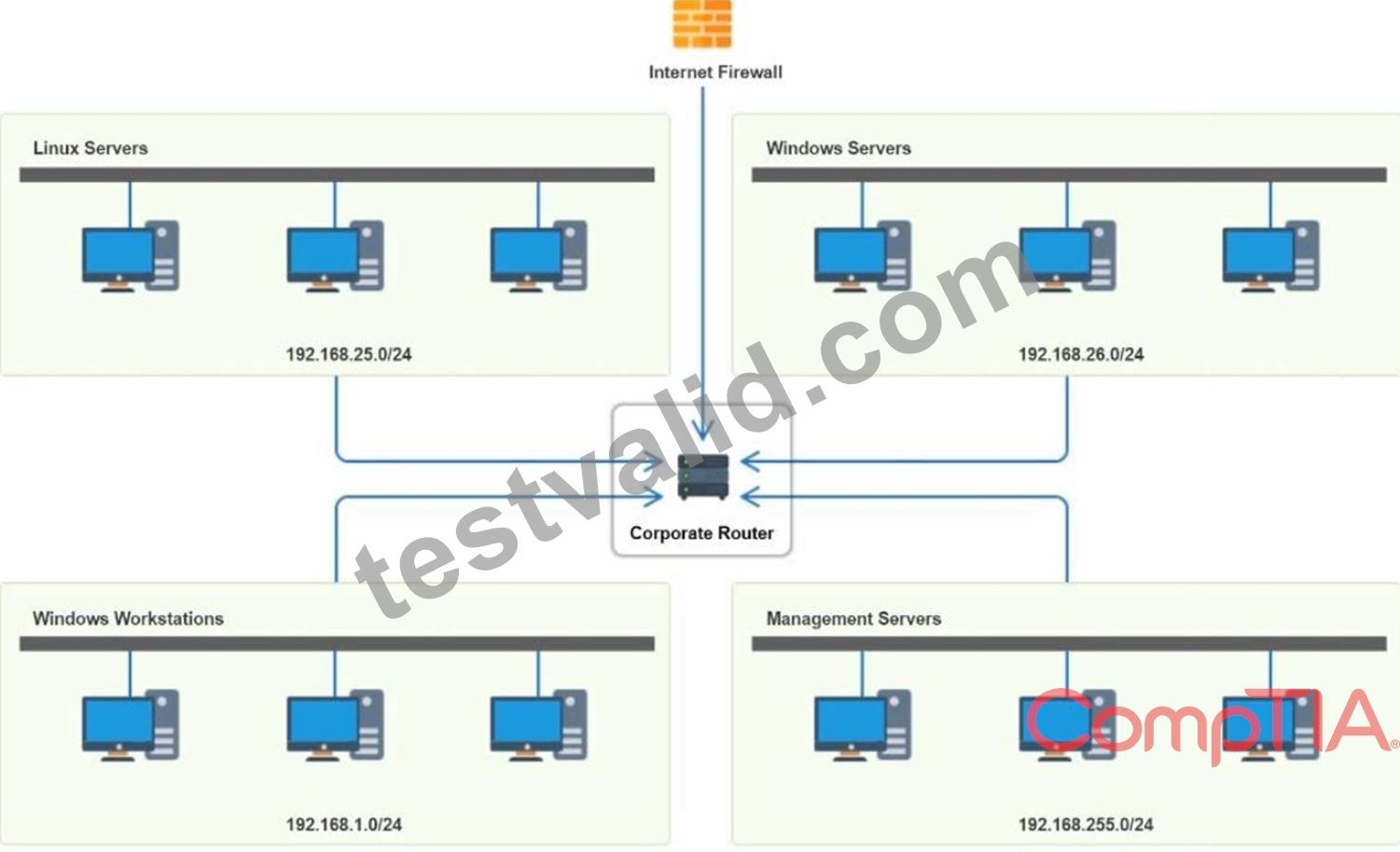

Answer:
Explanation:
NEW QUESTION # 147
A technician is planning an equipement installation into a rack in a data center that practices hot aisle/cold aise ventilation. Which of the following directions should the equipement exhaust face when installed in the rack?
- A. Sides
- B. Top
- C. Rear
- D. Front
Answer: C
Explanation:
In a data center that practices hot aisle/cold aisle ventilation, equipment should be installed so that the exhaust faces the rear of the rack. This setup ensures that hot air is expelled into the hot aisle, maintaining proper airflow and cooling efficiency.
Hot Aisle/Cold Aisle Configuration: Equipment intake should face the cold aisle where cool air is supplied, and exhaust should face the hot aisle where hot air is expelled.
Cooling Efficiency: Proper orientation of equipment helps maintain an efficient cooling environment by segregating hot and cold air, preventing overheating and improving energy efficiency.
Network Reference:
CompTIA Network+ N10-007 Official Certification Guide: Discusses data center design principles, including hot aisle/cold aisle configurations.
Cisco Data Center Design Guide: Provides best practices for data center layout and equipment installation.
Network+ Certification All-in-One Exam Guide: Covers data center environmental controls and ventilation strategies.
NEW QUESTION # 148
A network technician needs to resolve some issues with a customer's SOHO network. The customer reports that some of the PCs are not connecting to the network, while others appear to be working as intended.
INSTRUCTIONS
Troubleshoot all the network components.
Review the cable test results first, then diagnose by clicking on the appropriate PC, server, and Layer 2 switch.
Identify any components with a problem and recommend a solution to correct each problem.
If at any time you would like to bring back
the initial state of the simulation, please
click the Reset All button.


Answer:
Explanation:
See the answer and solution below: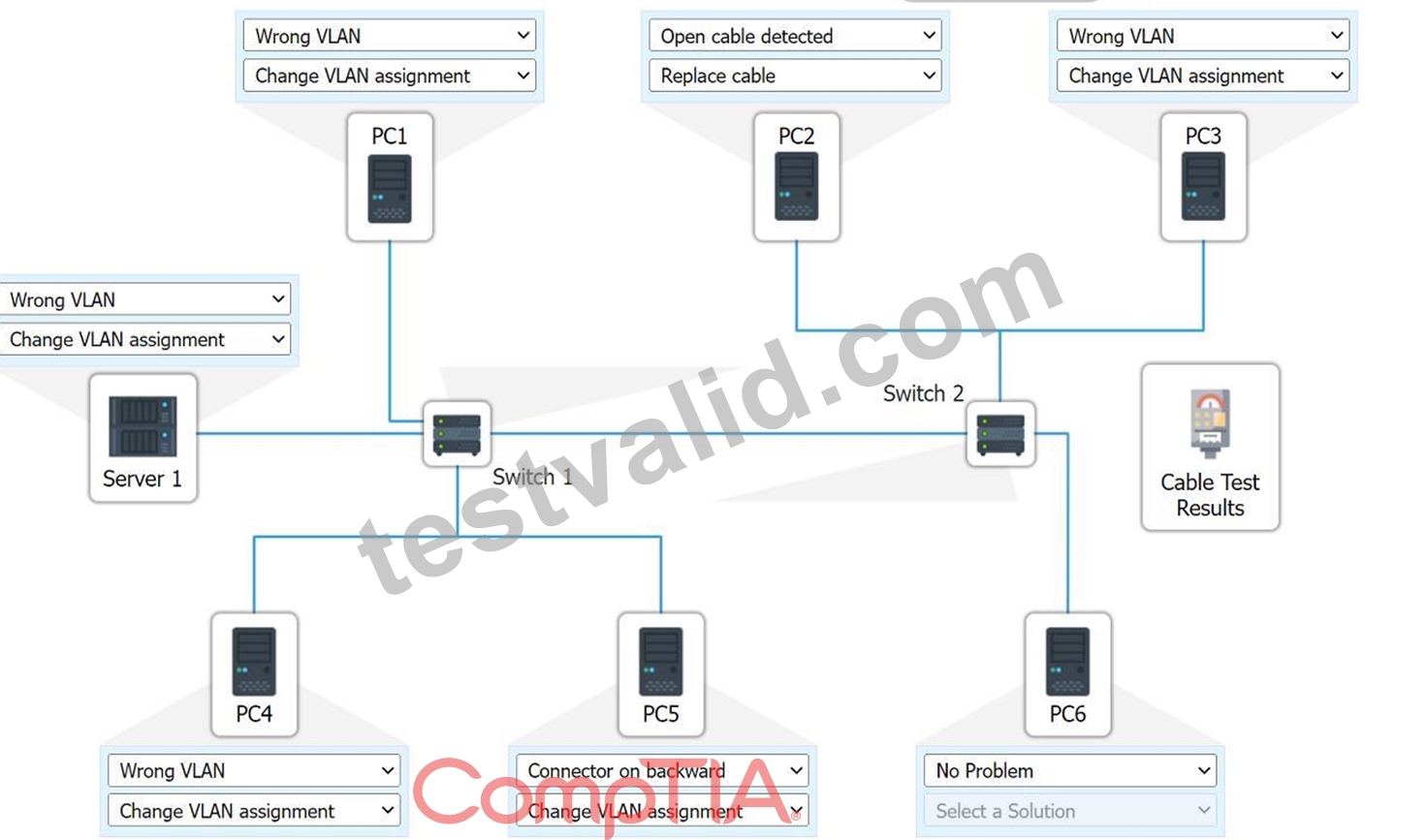
NEW QUESTION # 149
Which of the following most likely determines the size of a rack for installation? (Select two).
- A. Cooling fan speed
- B. KVM size
- C. Server height
- D. Switch depth
- E. Outlet amperage
- F. Hard drive size
Answer: D
Explanation:
* Understanding Rack Size Determination:
* The size of a rack for installation is determined by the dimensions of the equipment to be housed in it, primarily focusing on the depth and height of the devices.
* Switch Depth:
* Depth of Equipment: The depth of network switches and other rack-mounted devices directly influences the depth of the rack. If the equipment is deeper, a deeper rack is required to accommodate it.
* Industry Standards: Most racks come in standard depths, but it is essential to match the depth of the rack to the deepest piece of equipment to ensure proper fit and airflow.
* Server Height:
* Height of Equipment: The height of servers and other devices is measured in rack units (U), where 1U equals 1.75 inches. The total height of all equipment determines the overall height requirement of the rack.
* Rack Units: A rack's height is typically described in terms of the number of rack units it can accommodate, such as 42U, 48U, etc.
* Why Other Options are Less Relevant:
* KVM Size: While important for management, KVM (Keyboard, Video, Mouse) switches do not typically determine rack size.
* Hard Drive Size: Individual hard drives are installed within servers or storage devices, not directly influencing rack dimensions.
* Cooling Fan Speed: Fan speed affects cooling but not the physical size of the rack.
* Outlet Amperage: Power requirements do not determine rack dimensions but rather the electrical infrastructure supporting the rack.
References:
* CompTIA Network+ study materials on rack installation and equipment sizing.
NEW QUESTION # 150
Which of the following disaster recovery concepts is calculated by dividing the total hours of operation by the total number of units?
- A. MTTR
- B. RPO
- C. MTBF
- D. RTO
Answer: C
Explanation:
* Introduction to Disaster Recovery Concepts:
* Disaster recovery involves strategies and measures to ensure business continuity and data recovery in the event of a disaster.
* Mean Time Between Failures (MTBF):
* MTBF is a reliability metric used to predict the time between failures of a system during operation. It is calculated by dividing the total operational time by the number of failures.
* Formula:MTBF=Total Operational TimeNumber of Failures\text{MTBF} = \frac{\text{Total Operational Time}}{\text{Number of Failures}}MTBF=Number of FailuresTotal Operational Time
* This metric helps in understanding the reliability and expected lifespan of systems and components.
* Example Calculation:
* If a server operates for 1000 hours and experiences 2 failures, the MTBF is:
MTBF=1000 hours2=500 hours\text{MTBF} = \frac{1000 \text{ hours}}{2} = 500 \text{ hours}MTBF=21000 hours=500 hours
* Explanation of the Options:
* A. MTTR (Mean Time to Repair):The average time required to repair a system after a failure.
* B. MTBF (Mean Time Between Failures):The correct answer, representing the average time between failures.
* C. RPO (Recovery Point Objective):The maximum acceptable amount of data loss measured in time.
* D. RTO (Recovery Time Objective):The target time set for the recovery of IT and business activities after a disaster.
* Conclusion:
* MTBF is a crucial metric in disaster recovery and system reliability, helping organizations plan maintenance and predict system performance.
References:
* CompTIA Network+ guide explaining MTBF, MTTR, RPO, and RTO concepts and their calculations (see pageRef 10†How to Use Cisco Packet Tracer).
NEW QUESTION # 151
......
CompTIA Exam 2026 N10-009 Dumps Updated Questions: https://pass4sure.testvalid.com/N10-009-valid-exam-test.html