

[Jun-2025] UiPath-ADPv1 PDF Dumps Extremely Quick Way Of Preparation
Download UiPath-ADPv1 Dumps (2025) - Free PDF Exam Demo
UiPath UiPath-ADPv1 Exam Syllabus Topics:
| Topic | Details |
|---|---|
| Topic 1 |
|
| Topic 2 |
|
| Topic 3 |
|
| Topic 4 |
|
NEW QUESTION # 49
A developer configured the properties for a Click activity on an element inside a web page as shown in the following exhibit.
An animation on the web page never completely loads but the element indicated in the Click activity does load within the specified timeout duration. What occurs when this Click activity executes?
- A. Timeout error occurs without clicking on the element.
- B. Element is clicked once the element is fully loaded.
- C. Waits 10 seconds before clicking on the element.
- D. Continues to the next activity after 30 seconds without clicking on the element.
Answer: B
Explanation:
Click activity has the following properties:
*ClickType: Single
*MouseButton: Left
*Target.Timeout: 30000 ms (30 seconds)
*Target.WaitForReady: Interactive
The Target.Timeout property specifies the amount of time (in milliseconds) to wait for the activity to run before the SelectorNotFoundException error is thrown1. The default value is 30000 milliseconds (30 seconds)
2.
The Target.WaitForReady property determines how long the activity should wait for the target UI element to be ready before performing the action1. The following options are available:
*None: Does not wait for anything except the target UI element to exist before executing the action1.
*Interactive: Waits until only a part of the app is loaded1.
*Complete: Waits for the entire app to be loaded1.
The default value is Interactive2, which means that the activity will wait until the UI element is visible and can be interacted with3.
Therefore, based on these properties, the Click activity will wait for the element indicated by the selector to be loaded and clickable within 30 seconds. If the element is loaded before the timeout, the activity will click it and continue to the next activity. If the element is not loaded within the timeout, the activity will throw an error and stop the execution. The animation on the web page does not affect the Click activity, as long as the target element is loaded and visible. Hence, the correct answer is A. Element is clicked once the element is fully loaded.
NEW QUESTION # 50
In a UiPath coded automation, what does the DelayAsync method do?
- A. It suspends execution asynchronously for a specified period of time.
- B. It delays the termination of the automation by a specified period of time.
- C. It delays the start of the automation by a specified period of time.
- D. It adds a pause between the execution of each activity in the automation.
Answer: A
Explanation:
In UiPath coded workflows (using the SDK for .NET), theDelayAsyncmethod is used tosuspend execution asynchronouslyfor a specified duration. This allows the rest of the application to remain responsive while the delay occurs in a non-blocking fashion.
Reference:UiPath Developer Guide > Coded Workflows > Async Methods
NEW QUESTION # 51
What is the use of job priorities in unattended automations within UiPath Orchestrator?
- A. To create job dependencies that must be completed before new job execution.
- B. To determine which processes should be executed first when dealing with multiple jobs.
- C. To determine machine resource allocation among processes.
- D. To sort and organize tasks within a folder.
Answer: B
Explanation:
The use of job priorities in unattended automations within UiPath Orchestrator is to determine which processes should be executed first when dealing with multiple jobs. Job priorities are values that can be assigned to jobs or triggers when they are created or edited. The possible values are High, Normal, and Low.
Job priorities affect the order in which the jobs are executed by the robots, with higher priority jobs being executed before lower priority jobs. Job priorities can help you to optimize the execution of your unattended automations, especially when you have limited resources or time-sensitive processes. You can also use job priorities to create job dependencies that must be completed before new job execution, by using the Start Job activity with the Wait for completion option and setting the priority of the child job to High. References: [Job Priority], [Start Job]
NEW QUESTION # 52
A developer is building an automation which types text into a text file. The Activity Project Settings tor UI Automation Modern activities are set as follows:
The developer has configured the properties of a Type Into activity as follows:
What is the behavior of the Type Into activity when executing the workflow?
- A. The activity will remove a Single Line in Run mode and in Debug mode.
- B. The activity will use only properties set in Activity Project Settings.
- C. The activity will remove a Single Line in Run mode and Multi Line in Debug mode.
- D. The activity will remove Multi Line in Run mode and a Single Line in Debug mode.
Answer: C
Explanation:
The behavior of the Type Into activity when executing the workflow is that the activity will remove a Single Line in Run mode and Multi Line in Debug mode. This is because the activity has the Empty field property set to NEmptyFieldMode.SingleLine, which means that the activity will delete the existing content in the field by sending Ctrl+A and Delete keystrokes before typing the text. However, the activity also has the Debug mode property set to NEmptyFieldMode.MultiLine, which means that the activity will delete the existing content in the field by sending Ctrl+A, Shift+Home, and Delete keystrokes before typing the text. The Debug mode property overrides the Empty field property when the workflow is executed in Debug mode. Therefore, the activity will use different keystrokes to empty the field depending on the mode of execution. References:
[Type Into], [Empty Field], [Debug Mode]
NEW QUESTION # 53
The following table is stored in a variable called "dt".
What will the value of the qty variable be after executing the Assign activity?
- A. null
- B. 0
- C. 1
- D. 2
Answer: B
NEW QUESTION # 54
What is the purpose of the Capture All Elements feature in Object Repository?
- A. To capture the selected elements of an application from multiple screens simultaneously using the Computer Vision technology.
- B. To capture the selected elements of an application using the Computer Vision technology.
- C. To capture all elements of an application from multiple screens simultaneously using the Computer Vision technology.
- D. To capture all the available elements of an application using the Computer Vision technology.
Answer: D
Explanation:
The Object Repository is a feature of UiPath Studio that allows you to store and manage UI elements that are used in your automation projects. You can create and edit UI descriptors for the UI elements, and reuse them across multiple workflows and projects. The Object Repository supports both the default UI framework and the Computer Vision framework for identifying UI elements.
The Computer Vision framework is a technology that uses artificial intelligence and machine learning to analyze the UI of any application and provide reliable selectors for the UI elements. The Computer Vision framework can handle complex and dynamic UIs that are not supported by the default UI framework, such as Citrix, SAP, or PDF applications.
The Capture All Elements feature in Object Repository is a feature that allows you to capture all the available elements of an application using the Computer Vision technology. You can use this feature to quickly and easily create UI descriptors for all the UI elements on the screen, without having to indicate each element individually. You can access this feature by clicking the Capture All Elements button on the Object Repository ribbon tab, or by using the Capture All Elements activity in the workflow.
The Capture All Elements feature has the following benefits:
It saves time and effort by capturing all the UI elements in one go, instead of indicating each element separately.
It ensures consistency and accuracy by using the same Computer Vision technology and selector logic for all the UI elements.
It allows you to edit, rename, or delete the UI descriptors after capturing them, and customize them according to your needs.
It enables you to reuse the UI descriptors across multiple workflows and projects, and share them with other developers.
The correct answer is C. To capture all the available elements of an application using the Computer Vision technology. This statement accurately describes the purpose of the Capture All Elements feature in Object Repository.
The other options are not correct statements. Option A is incorrect, because the Capture All Elements feature does not capture the selected elements of an application, but all the available elements. It also does not capture the elements from multiple screens simultaneously, but only from the current screen. Option B is incorrect, because the Capture All Elements feature does not capture the selected elements of an application, but all the available elements. Option D is incorrect, because the Capture All Elements feature does not capture the elements from multiple screens simultaneously, but only from the current screen.
References: Studio - Object Repository - UiPath Documentation Portal, Activities - Capture All Elements - UiPath Documentation Portal, Computer Vision - Introduction - UiPath Documentation Portal, Object Repository - UiPath Academy
NEW QUESTION # 55
What is the purpose of the Invoke Code activity in UiPath?
- A. Invokes VB MET code optionally passing it a list of input arguments
- B. Invokes Java code, optionally passing it a list of input arguments.
- C. Invokes VB MET or Java code optionally passing it a list of input arguments
- D. Invokes VB.NET or C# code, optionally passing il a list of input arguments.
Answer: D
NEW QUESTION # 56
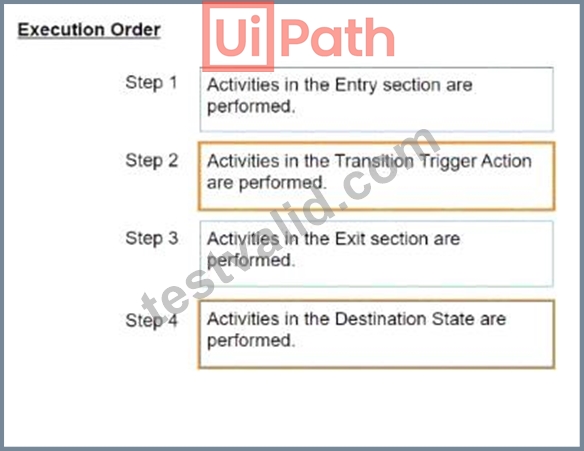
What is the correct execution order of the State activity sections?
instructions: Drag the Description found on the "Left" and drop on the correct Execution Order found on the
"Right"
Answer:
Explanation:
NEW QUESTION # 57
Which activity Is specific tor Ul synchronization in UlPath Studio?
- A. Use Applicationy/Browser
- B. Check App State
- C. Process Start Trigger
- D. Get Processes
Answer: B
Explanation:
The Check App State activity is specifically designed for UI synchronization. It checks the state of a UI element, ensuring that subsequent actions are performed when the UI element is in the desired state.
NEW QUESTION # 58
Given the following workflow:
What will be the output of the Log Message activity?
- A. apple, pear, orange
- B. apple, pear, orange, mango, kiwi
- C. "apple pear orange", "mango kiwi"
- D. apple pear orange, mango kiwi
Answer: B
NEW QUESTION # 59
What is the use of job priorities in unattended automations within UiPath Orchestrator?
- A. To create job dependencies that must be completed before new job execution.
- B. To determine which processes should be executed first when dealing with multiple jobs.
- C. To determine machine resource allocation among processes.
- D. To sort and organize tasks within a folder.
Answer: B
Explanation:
The use of job priorities in unattended automations within UiPath Orchestrator is to determine which processes should be executed first when dealing with multiple jobs. Job priorities are values that can be assigned to jobs or triggers when they are created or edited. The possible values are High, Normal, and Low. Job priorities affect the order in which the jobs are executed by the robots, with higher priority jobs being executed before lower priority jobs. Job priorities can help you to optimize the execution of your unattended automations, especially when you have limited resources or time-sensitive processes. You can also use job priorities to create job dependencies that must be completed before new job execution, by using the Start Job activity with the Wait for completion option and setting the priority of the child job to High. References: [Job Priority],
[Start Job]
NEW QUESTION # 60
In the context of UiPath Orchestrator, what is the primary purpose of the Monitoring feature?
- A. Consolidating event logs and records related to executed tasks and runtime anomalies.
- B. Facilitating the design and deployment of automation workflows.
- C. Real-time tracking of Robots, Machines, Queues, and Jobs.
- D. Handling version control and collaboration among team members.
Answer: C
Explanation:
The Monitoring feature in UiPath Orchestrator is a solution that provides real-time metrics to help you keep an eye on the health and state of your system1. It enables you to check the status and performance of your Robots, Machines, Queues, and Jobs in either the last hour or last day1. You can also use the Monitoring feature to filter, sort, and search for specific resources, view detailed information and charts for each resource, and access the Error Feed widget to see the errors that occurred during execution1.
The other options are incorrect because:
Option A describes the purpose of the Source Control feature in UiPath Studio, which allows you to manage your automation projects using Git or TFS2.
Option C describes the purpose of the Processes feature in UiPath Orchestrator, which allows you to deploy, configure, and run automation workflows on Robots3.
Option D describes the purpose of the Logs feature in UiPath Orchestrator, which allows you to view and download event logs and records related to executed tasks and runtime anomalies.
References:
Orchestrator - About Monitoring - UiPath Documentation Portal
Studio - Source Control - UiPath Documentation Portal
Orchestrator - Processes - UiPath Documentation Portal
[Orchestrator - Logs - UiPath Documentation Portal]
NEW QUESTION # 61
What is the purpose of the Invoke Code activity in UiPath?
- A. Invokes VB MET code optionally passing it a list of input arguments
- B. Invokes Java code, optionally passing it a list of input arguments.
- C. Invokes VB MET or Java code optionally passing it a list of input arguments
- D. Invokes VB.NET or C# code, optionally passing il a list of input arguments.
Answer: D
Explanation:
The purpose of the Invoke Code activity in UiPath is to invoke VB.NET or C# code, optionally passing it a list of input arguments. The Invoke Code activity allows the developer to write and execute custom code in VB.NET or C# within a UiPath workflow. The Invoke Code activity has a Code property, where the developer can enter the code to be executed. The Invoke Code activity also has an Arguments property, where the developer can specify the input and output arguments for the code. The Invoke Code activity can be useful for performing complex calculations, manipulating data, or integrating with external libraries or applications that are not supported by the existing UiPath activities. References: [Invoke Code]
NEW QUESTION # 62
Which of the following credentials stores have built in support in Orchestrator?
- A. Azure Key Vault, CyberArk CCP, HashiCorp Vault, Thycotic Secret Server, BeyondTrust, CyberArk.
- B. CyberArk CCP, Azure Key Vault, Google Credentials, Amazon Security Services.
- C. Cisco, Amazon Security Services, Google Credentials, Microsoft SCS, IBM Vault.
- D. CyberArk CCP, Cisco, Google Credentials, CyberArk, Azure Key Vault.
Answer: A
Explanation:
UiPath Orchestrator provides integration capabilities with various credential stores to securely store and manage credentials such as usernames and passwords, API keys, and other secrets. The built-in support for credential stores in Orchestrator includes:
*Azure Key Vault: A cloud service provided by Microsoft that safeguards cryptographic keys and other secrets used by cloud applications and services.
*CyberArk Credential Provider (CCP): CyberArk's enterprise-grade solution designed to secure, manage, and monitor privileged accounts and credentials.
*HashiCorp Vault: A tool for secrets management, encrypting sensitive data, and access control across dynamic infrastructure.
*Thycotic Secret Server: An enterprise-level solution for privileged account management and protection of critical enterprise passwords and secrets.
*BeyondTrust: A privileged access management platform that secures and manages access to critical assets, passwords, and endpoints.
*CyberArk: In addition to the CCP, Orchestrator supports integration with other CyberArk solutions for secure credential management.
These integrations allow Orchestrator to retrieve credentials securely at runtime for use in automation workflows, enhancing the security posture by avoiding hard-coded or plaintext credentials in automation scripts.
References:
*UiPath Orchestrator Guide: Managing Credentials
*UiPath Orchestrator Guide: About Credential Stores
NEW QUESTION # 63
What is a prerequisite for performing Remote Debugging using an Unattended Robot connection?
- A. Studio and the remote robot have the same version.
- B. TCP/IP connectivity exists between the Studio machine and the remote machine
- C. Studio and the remote robot must be connected to the same Orchestrator tenant.
- D. The same user must be signed in Studio and the remote robot.
Answer: C
Explanation:
on the prerequisite for performing Remote Debugging using an Unattended Robot connection:
* The prerequisite is that Studio and the remote robot must be connected to the same Orchestrator tenant.
This ensures that Studio can communicate with the remote robot for debugging purposes. While having the same version and TCP/IP connectivity is beneficial, the key requirement for remote debugging is the connection to the same Orchestrator tenant.
NEW QUESTION # 64
In the context of the REFramework, if the OrchestratorQueueName key is present in both the Settings and Assets sheets, but an asset with the corresponding name is not present in Orchestrator, what will be the behavior at run time?
- A. An empty string will be saved for the "OrchestratorQueueName" key in the config dictionary.
- B. The flow will throw an exception in InitAllSettings workflow.
- C. The flow will use the value from the Settings sheets since the asset is missing.
- D. The "OrchestratorQueueName" key is not added to the config dictionary and the flow will throw in Get Transaction Data workflow.
Answer: B
Explanation:
In the Robotic Enterprise Framework (REFramework) for UiPath, the OrchestratorQueueName key is used to specify the name of the queue from which the robot will process transactions. If the OrchestratorQueueName key is specified in both the Settings sheet and the Assets sheet of the configuration, the REFramework will first attempt to get the value from the Orchestrator asset.
If the asset with the corresponding name to OrchestratorQueueName is not found in Orchestrator, the behavior at runtime would depend on how the REFramework's InitAllSettings.xaml is implemented. Generally, if an asset is expected but not found in the Orchestrator, an exception is thrown because the asset is typically considered a required component for the process to run correctly.
Therefore, the most likely behavior at runtime would be:
B: The flow will throw an exception in the InitAllSettings workflow.
This would occur because the InitAllSettings workflow contains the logic to load configuration settings and assets, and if an expected asset is not found, an exception is usually thrown to prevent the process from continuing without required configuration.
NEW QUESTION # 65
What actions must be manually selected in the App/Web Recorder before recording a step?
- A. Copy text using the Get Text activity.
Hover over an element using the Hover activity.
Click on buttons, links, and other clickable elements such as icons or images.
Type text in a text area such as a text box.
Select or clear a check box. - B. Click on buttons, links, and other clickable elements such as icons or images.
Type text in a text area such as a text box.
Select or clear a check box.
Send keyboard shortcuts using your keyboard.
Select an item from a drop-down. - C. Select or clear a check box.
Send keyboard shortcuts using your keyboard.
Select an item from a drop-down. - D. Copy text using the Get Text activity.
Hover over an element using the Hover activity.
Highlight an element using the Highlight activity.
Answer: B
Explanation:
In UiPath's App/Web Recorder, certain actions need to be selected or indicated before they can be recorded.
These include:
*Clicking on buttons, links, and other interactive elements.
*Typing text into input fields.
*Selecting or clearing checkboxes.
*Sending keyboard shortcuts.
*Selecting items from drop-down menus.
Based on these common actions that are typically used in UiPath recording, the answer that best fits is:
A: Click on buttons, links, and other clickable elements such as icons or images. Type text in a text area such as a text box. Select or clear a check box. Send keyboard shortcuts using your keyboard. Select an item from a drop-down.
These are the actions that you would manually select or perform during the recording process to automate interactions with a UI.
NEW QUESTION # 66
A developer configured the properties for a Click activity as shown below:
What happens if the activity cannot find its target at runtime?
- A. The next activity is executed after 10 milliseconds.
- B. An exception is thrown after 10 milliseconds.
- C. An exception is thrown after 10 seconds.
- D. The next activity is executed after 10 seconds.
Answer: C
Explanation:
The Click activity has a property called TimeoutMS. This property specifies the amount of time (in milliseconds) to wait for the activity to be executed before an error is thrown. In this case, the TimeoutMS property is set to 10000 milliseconds (10 seconds). Therefore, if the activity cannot find its target at runtime, an exception will be thrown after 10 seconds.
NEW QUESTION # 67
Considering that the attached table is stored in a variable called "dt":
Which LINQ query can be used to return the maximum total Quantity?
- A. dt.AsEnumerable. GroupBy(Function(x) x("Item").ToString). Max(Function(x) x.Sum(Function(y) Convert.ToInt32(y("Quantity").ToString)))
- B. dt.AsEnumerable. OrderByDescending(Function(x) Convert.ToInt32(x("Quantity").ToString)). First.Item("Quantity")
- C. dt.AsEnumerable. Max(Function(x) Convert.ToInt32(x("Quantity").ToString))
- D. dt.AsEnumerable. Max(Function(x) Convert.ToInt32(x("Quantity").ToString))("Item")
Answer: A
NEW QUESTION # 68
What Information is provided in the Descriptor Coverage sub-panel of Test Explorer?
- A. Test data coverage
- B. Object Repository coverage
- C. Selector coverage
- D. Activity coverage
Answer: C
Explanation:
The Descriptor Coverage sub-panel in the Test Explorer provides Selector coverage information. This coverage data is crucial for understanding how well the selectors in a project are being tested.
NEW QUESTION # 69
What is the recommended approach for a user to log custom information at each breakpoint while executing a process in Debug mode?
- A. Set Log Message option in the Breakpoint Settings.
- B. Select Log Activities from the Debug panel.
- C. Select Execution Trail from the Debug panel.
- D. Insert a Log Message before each activity with a breakpoint.
Answer: A
Explanation:
The Log Message option in the Breakpoint Settings allows the user to log custom information at each breakpoint while executing a process in Debug mode. This option can be accessed by right-clicking on a breakpoint and selecting Breakpoint Settings. The user can then enter a message that will be logged in the Output panel when the breakpoint is hit. The message can include variables, arguments, and pseudovariables, such as $PID, $TID, $FUNCTION, etc1 Option B is not recommended, because it requires the user to insert a Log Message activity before each activity with a breakpoint, which can be tedious and clutter the workflow. Option C is not relevant, because it enables or disables logging for all activities in the project, not just the breakpoints. Option D is not related, because it shows the execution flow of the process, not the custom information at each breakpoint.
References: 1: Studio - The Breakpoints Panel
NEW QUESTION # 70
A developer aims to employ the REFramework for automating a business process that Involves a TransactionData collection (DataTable) comprising vendor names and addresses.
Instructions: Choose the appropriate variable type for the Transactionltem from the provided drop-down list in the following exhibit.

Answer:
Explanation:
Explanation:
The REFramework (Robotic Enterprise Framework) in UiPath is designed to work with transactional data. For a process that involves iterating over a DataTable where each row represents a transaction item, the appropriate variable type for the TransactionItem would be a DataRow.
In the context of REFramework, a DataRow is typically used to represent a single transaction item when the transaction data is contained within a DataTable. This allows the framework to process each row (or transaction) one by one.
Therefore, the correct variable type for the TransactionItem from the drop-down list should be DataRow.
NEW QUESTION # 71
In the context of a process automated using the REFramework that processes payments and sends a report using the Finance team leader's email account at the end of the day. where should the email account credentials be stored according to best practices''
- A. In the Constants sheet in the Config.xlsx file with the value of the email address.
- B. In an Orchestrator Text asset and referenced in the Assets sheet In the Config.xlsx file.
- C. In an Orchestrator Credential asset and referenced in the Settings sheet in the Config.xlsx file.
- D. In an Orchestrator Credential asset and referenced in the Assets sheet in the Config.xlsx file.
Answer: D
Explanation:
In the REFramework, best practices suggest storing sensitive information like email account credentials in an Orchestrator Credential asset. This asset is then referenced in the Config.xlsx file, specifically in the Assets sheet, ensuring secure and centralized management of credentials.
NEW QUESTION # 72
A developer intends to enter text into an input field using a combination of a string and a hotkey. The input action should take place within a hidden or minimized window.
Which input method(s) can be used individually for the Type Into activity?
- A. Window Messages only.
- B. Simulate and Window Messages.
- C. Simulate only.
- D. Same as App/Browser and Simulate.
Answer: B
Explanation:
The Type Into activity has three input methods: Default, Simulate, and Window Messages. The Default method uses hardware drivers to send keystrokes to the target application, which means it requires the window to be active and visible. The Simulate and Window Messages methods use software drivers to send keystrokes to the target application, which means they can work in the background, even if the window is hidden or minimized. However, the Simulate method cannot send hotkeys, while the Window Messages method can. Therefore, the only input methods that can be used individually for the Type Into activity to enter text and hotkeys in a hidden or minimized window are Simulate and Window Messages. References:
*Type Into
*Input Methods
NEW QUESTION # 73
On 10/04/2023 five Queue Items were added to a queue. What is the appropriate processing sequence for Queue Items based on their properties?
Instructions: Drag the Queue Item found on the "Left" and drop on the correct Process Sequence found on the
"Right".
Answer:
Explanation:
Explanation:
The processing sequence for queue items in UiPath Orchestrator is determined primarily by the deadline and priority of each item. Items with an earlier deadline are processed first. If multiple items have the same deadline, then priority determines the order: High, Normal, then Low.
Following this logic, the processing sequence would be:
1st: Deadline = 10/04/2023 Priority = LowSince this is the only item with the deadline of the current day (assuming today is 10/04/2023), it should be processed first regardless of its priority.
2nd: No deadline Priority = HighAlthough this item has no deadline, its high priority places it next in the sequence after items with a deadline for the current day.
3rd: Deadline = 10/05/2023 Priority = HighThis item is next due to its combination of an imminent deadline and high priority.
4th: Deadline = 10/05/2023 Priority = NormalThis item has the same deadline as the third but a lower priority, so it comes next.
5th: Deadline = 10/06/2023 Priority = HighThis item, while high priority, has the latest deadline, so it is processed last.
So the order would be:
1st: Deadline = 10/04/2023 Priority = Low2nd: No deadline Priority = High3rd: Deadline = 10/05/2023 Priority = High4th: Deadline = 10/05/2023 Priority = Normal5th: Deadline = 10/06/2023 Priority = High
NEW QUESTION # 74
......
Enhance your career with UiPath-ADPv1 PDF Dumps - True UiPath Exam Questions: https://pass4sure.testvalid.com/UiPath-ADPv1-valid-exam-test.html