

HP HPE6-A84 Exam Preparation Guide and PDF Download
Verified & Correct HPE6-A84 Practice Test Reliable Source Jan 12, 2024 Updated
HPE6-A84 exam is a certification exam offered by HP for individuals seeking to become Aruba Certified Network Security Experts. HPE6-A84 exam is designed to test the knowledge and skills required to plan, design, implement, and manage secure enterprise wireless networks using Aruba technology.
NEW QUESTION # 16
Refer to the scenario.
A customer requires these rights for clients in the "medical-mobile" AOS firewall role on Aruba Mobility Controllers (MCs):
Permitted to receive IP addresses with DHCP
Permitted access to DNS services from 10.8.9.7 and no other server
Permitted access to all subnets in the 10.1.0.0/16 range except denied access to 10.1.12.0/22 Denied access to other 10.0.0.0/8 subnets Permitted access to the Internet Denied access to the WLAN for a period of time if they send any SSH traffic Denied access to the WLAN for a period of time if they send any Telnet traffic Denied access to all high-risk websites External devices should not be permitted to initiate sessions with "medical-mobile" clients, only send return traffic.
The line below shows the effective configuration for the role.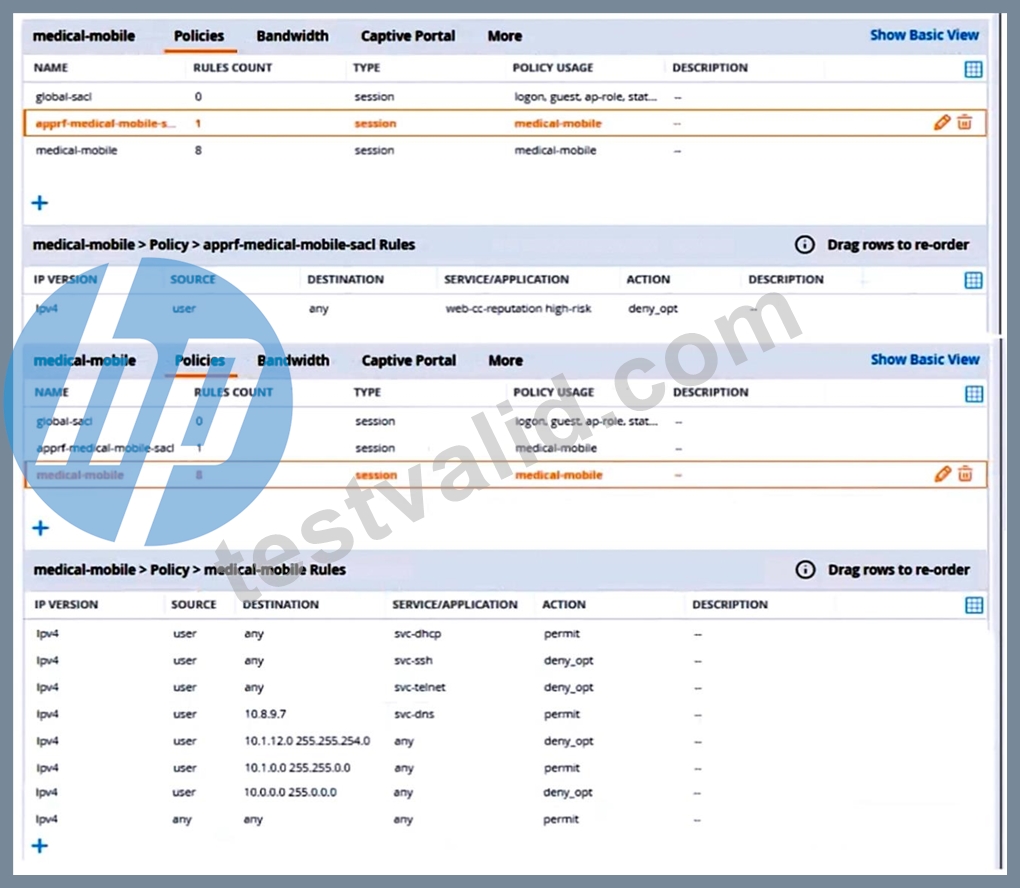
There are multiple issues with this configuration. What is one change you must make to meet the scenario requirements? (In the options, rules in a policy are referenced from top to bottom. For example,
"medical-mobile" rule 1 is "ipv4 any any svc-dhcp permit," and rule 6 is "ipv4 any any any permit'.)
- A. Apply the "apprf-medical-mobile-sjcT policy explicitly to the 'medical-mobile' user-role under the
'medical-mobile" policy. - B. In the "medical-mobile" policy, change the action for rules 2 and 3 to reject.
- C. In the "medical-mobile" policy, move rule 5 under rule 6.
- D. In the "medical-mobile* policy, change the subnet mask in rule 5 to 255.255.252.0.
Answer: D
NEW QUESTION # 17
Refer to the scenario.
An organization wants the AOS-CX switch to trigger an alert if its RADIUS server (cp.acnsxtest.local) rejects an unusual number of client authentication requests per hour. After some discussions with other Aruba admins, you are still not sure how many rejections are usual or unusual. You expect that the value could be different on each switch.
You are helping the developer understand how to develop an NAE script for this use case.
You are helping the developer find the right URI for the monitor.
Refer to the exhibit.
You have used the REST API reference interface to submit a test call. The results are shown in the exhibit.
Which URI should you give to the developer?
- A. /rest/v1/system/vrfs/mgmt/radius/_servers/cp.acnsxtest.local/2083/tcp
- B. /rest/v1/system/vrfs/mgmt/radius/servers/cp.acnsxtest.local/2083/tcp?attributes=authstatistics.access_rejec
- C. /rest/v1/system/vrfs/mgmt/radius/servers/cp.acnsxtest.local/2083/tcp?attributes=authstatistics
- D. /rest/v1/system/vrfs/mgmt/radius/servers/cp.acnsxtest.local/2083/tcp?attributes=authstatistics?attributes=a
Answer: B
NEW QUESTION # 18
Refer to the scenario.
A customer has asked you to review their AOS-CX switches for potential vulnerabilities. The configuration for these switches is shown below:
What is one immediate remediation that you should recommend?
- A. Setting the clock manually instead of using NTP
- B. Changing the switch's DNS server to the mgmt VRF
- C. Disabling Telnet
- D. Either disabling DHCPv4-snoopinq or leaving it enabled, but also enabling ARP inspection
Answer: C
Explanation:
Explanation
According to the AOS-CX Switches Multiple Vulnerabilities1, one of the vulnerabilities (CVE-2021-41001) affects the Telnet service on AOS-CX switches. This vulnerability allows an unauthenticated remote attacker to cause a denial-of-service condition on the switch by sending specially crafted Telnet packets. The impact of this vulnerability is high, as it could result in a loss of management access and network disruption. Therefore, one immediate remediation that you should recommend is to disable Telnet on the switch. This way, the switch can prevent any malicious Telnet traffic from reaching it and avoid the exploitation of this vulnerability.
NEW QUESTION # 19
Refer to the scenario.
# Introduction to the customer
You are helping a company add Aruba ClearPass to their network, which uses Aruba network infrastructure devices.
The company currently has a Windows domain and Windows CA. The Window CA issues certificates to domain computers, domain users, and servers such as domain controllers. An example of a certificate issued by the Windows CA is shown here.

The company is in the process of adding Microsoft Endpoint Manager (Intune) to manage its mobile clients.
The customer is maintaining the on-prem AD for now and uses Azure AD Connect to sync with Azure AD.
# Requirements for issuing certificates to mobile clients
The company wants to use ClearPass Onboard to deploy certificates automatically to mobile clients enrolled in Intune. During this process, Onboard should communicate with Azure AD to validate the clients. High availability should also be provided for this scenario; in other words, clients should be able to get certificates from Subscriber 2 if Subscriber 1 is down.
The Intune admins intend to create certificate profiles that include a UPN SAN with the UPN of the user who enrolled the device.
# Requirements for authenticating clients
The customer requires all types of clients to connect and authenticate on the same corporate SSID.
The company wants CPPM to use these authentication methods:
* EAP-TLS to authenticate users on mobile clients registered in Intune
* TEAR, with EAP-TLS as the inner method to authenticate Windows domain computers and the users on them To succeed, EAP-TLS (standalone or as a TEAP method) clients must meet these requirements:
Their certificate is valid and is not revoked, as validated by OCSP
The client's username matches an account in AD
# Requirements for assigning clients to roles
After authentication, the customer wants the CPPM to assign clients to ClearPass roles based on the following rules:
* Clients with certificates issued by Onboard are assigned the "mobile-onboarded" role
* Clients that have passed TEAP Method 1 are assigned the "domain-computer" role Clients in the AD group "Medical" are assigned the "medical-staff" role Clients in the AD group "Reception" are assigned to the "reception-staff" role The customer requires CPPM to assign authenticated clients to AOS firewall roles as follows:
* Assign medical staff on mobile-onboarded clients to the "medical-mobile" firewall role
* Assign other mobile-onboarded clients to the "mobile-other" firewall role
* Assign medical staff on domain computers to the "medical-domain" firewall role
* All reception staff on domain computers to the "reception-domain" firewall role
* All domain computers with no valid user logged in to the "computer-only" firewall role
* Deny other clients access
# Other requirements
Communications between ClearPass servers and on-prem AD domain controllers must be encrypted.
# Network topology
For the network infrastructure, this customer has Aruba APs and Aruba gateways, which are managed by Central. APs use tunneled WLANs, which tunnel traffic to the gateway cluster. The customer also has AOS-CX switches that are not managed by Central at this point.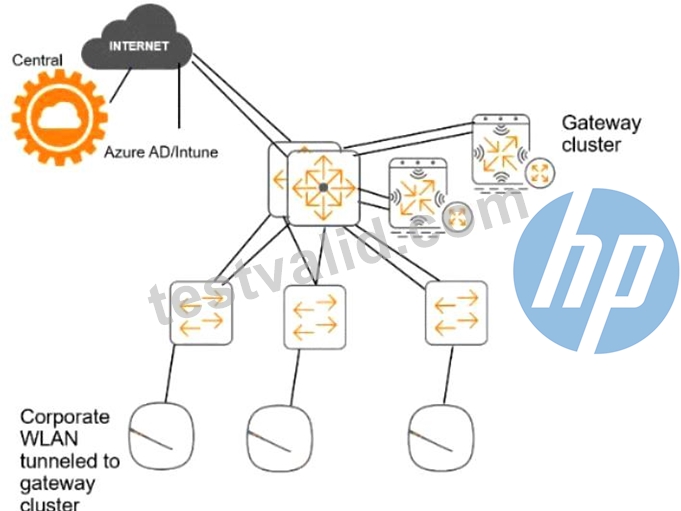
# ClearPass cluster IP addressing and hostnames
A customer's ClearPass cluster has these IP addresses:
* Publisher = 10.47.47.5
* Subscriber 1 = 10.47.47.6
* Subscriber 2 = 10.47.47.7
* Virtual IP with Subscriber 1 and Subscriber 2 = 10.47.47.8
The customer's DNS server has these entries
* cp.acnsxtest.com = 10.47.47.5
* cps1.acnsxtest.com = 10.47.47.6
* cps2.acnsxtest.com = 10.47.47.7
* radius.acnsxtest.com = 10.47.47.8
* onboard.acnsxtest.com = 10.47.47.8
You have started to create a CA to meet the customer's requirements for issuing certificates to mobile clients, as shown in the exhibit below.
What change will help to meet those requirements and the requirements for authenticating clients?
- A. Recreate the CA as a registration authority under Azure AD.
- B. Change the EST authentication method to use an external validator.
- C. Change the EST Digest Algorithm to SHA-512.
- D. Specify an OCSP responder, setting the hostname to localhost.
Answer: B
NEW QUESTION # 20
Refer to the scenario.
This customer is enforcing 802.1X on AOS-CX switches to Aruba ClearPass Policy Manager (CPPM). The customer wants switches to download role settings from CPPM. The "reception-domain" role must have these settings:
- Assigns clients to VLAN 14 on switch 1, VLAN 24 on switch 2, and so on.
- Filters client traffic as follows:
- Clients are permitted full access to 10.1.5.0/24 and the Internet
- Clients are denied access to 10.1.0.0/16
The switch topology is shown here:
How should you configure the VLAN setting for the reception role?
- A. Configure the enforcement profile as a downloadable role, but specify only the role name and leave the VLAN undefined. Then define a 'reception' role with the correct VLAN setting on each individual access layer switch.
- B. Create a separate enforcement profile with a different VLAN ID for each switch. Add all profiles to the profile list in the appropriate enforcement policy rule.
- C. Assign a number-based ID to the access layer switches. Then use this variable in the enforcement profile VLAN settings: %(NAS-ID]4.
- D. Assign a consistent name to VLAN 14, 24, or 34 on each access layer switch and reference that name in the enforcement profile VLAN settings.
Answer: D
Explanation:
Explanation
According to the AOS-CX User Guide, one way to configure the VLAN setting for the reception role is to assign a consistent name to VLAN 14, 24, or 34 on each access layer switch and reference that name in the enforcement profile VLAN settings. This way, the switches can download the role settings from CPPM and apply the correct VLAN based on the name, rather than the ID. For example, the enforcement profile VLAN settings could be:
And the VLAN configuration on each switch could be:
NEW QUESTION # 21
Refer to the scenario.
# Introduction to the customer
You are helping a company add Aruba ClearPass to their network, which uses Aruba network infrastructure devices.
The company currently has a Windows domain and Windows CA. The Window CA issues certificates to domain computers, domain users, and servers such as domain controllers. An example of a certificate issued by the Windows CA is shown here.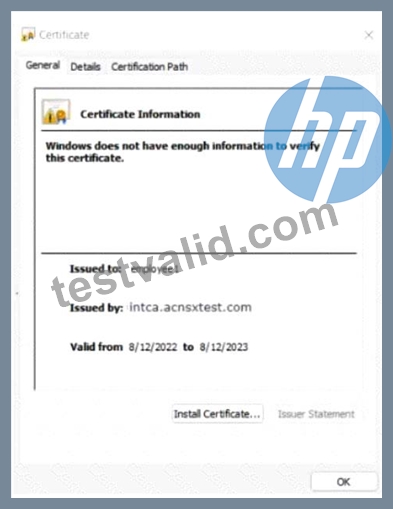
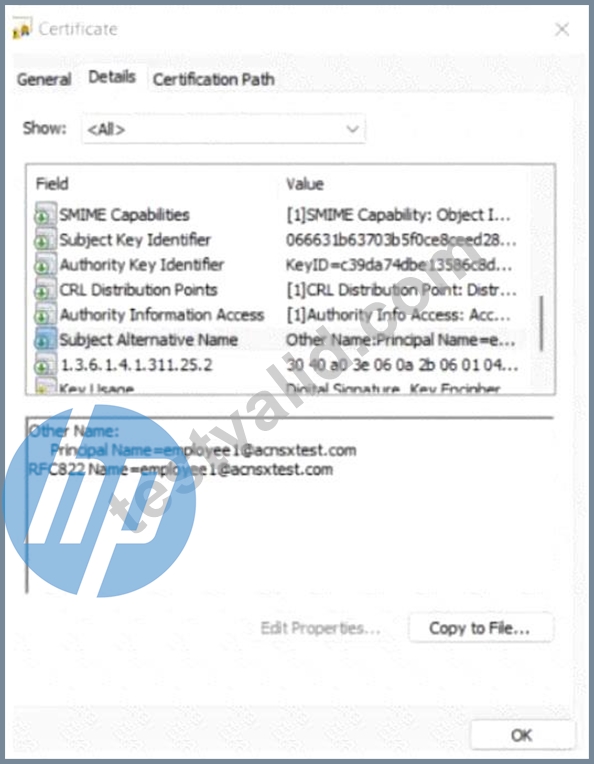
The company is in the process of adding Microsoft Endpoint Manager (Intune) to manage its mobile clients.
The customer is maintaining the on-prem AD for now and uses Azure AD Connect to sync with Azure AD.
# Requirements for issuing certificates to mobile clients
The company wants to use ClearPass Onboard to deploy certificates automatically to mobile clients enrolled in Intune. During this process, Onboard should communicate with Azure AD to validate the clients. High availability should also be provided for this scenario; in other words, clients should be able to get certificates from Subscriber 2 if Subscriber 1 is down.
The Intune admins intend to create certificate profiles that include a UPN SAN with the UPN of the user who enrolled the device.
# Requirements for authenticating clients
The customer requires all types of clients to connect and authenticate on the same corporate SSID.
The company wants CPPM to use these authentication methods:
EAP-TLS to authenticate users on mobile clients registered in Intune
TEAR, with EAP-TLS as the inner method to authenticate Windows domain computers and the users on them To succeed, EAP-TLS (standalone or as a TEAP method) clients must meet these requirements:
Their certificate is valid and is not revoked, as validated by OCSP
The client's username matches an account in AD
# Requirements for assigning clients to roles
After authentication, the customer wants the CPPM to assign clients to ClearPass roles based on the following rules:
Clients with certificates issued by Onboard are assigned the "mobile-onboarded" role Clients that have passed TEAP Method 1 are assigned the "domain-computer" role Clients in the AD group "Medical" are assigned the "medical-staff" role Clients in the AD group "Reception" are assigned to the "reception-staff" role The customer requires CPPM to assign authenticated clients to AOS firewall roles as follows:
Assign medical staff on mobile-onboarded clients to the "medical-mobile" firewall role Assign other mobile-onboarded clients to the "mobile-other" firewall role Assign medical staff on domain computers to the "medical-domain" firewall role All reception staff on domain computers to the "reception-domain" firewall role All domain computers with no valid user logged in to the "computer-only" firewall role Deny other clients access
# Other requirements
Communications between ClearPass servers and on-prem AD domain controllers must be encrypted.
# Network topology
For the network infrastructure, this customer has Aruba APs and Aruba gateways, which are managed by Central. APs use tunneled WLANs, which tunnel traffic to the gateway cluster. The customer also has AOS-CX switches that are not managed by Central at this point.
# ClearPass cluster IP addressing and hostnames
A customer's ClearPass cluster has these IP addresses:
Publisher = 10.47.47.5
Subscriber 1 = 10.47.47.6
Subscriber 2 = 10.47.47.7
Virtual IP with Subscriber 1 and Subscriber 2 = 10.47.47.8
The customer's DNS server has these entries
cp.acnsxtest.com = 10.47.47.5
cps1.acnsxtest.com = 10.47.47.6
cps2.acnsxtest.com = 10.47.47.7
radius.acnsxtest.com = 10.47.47.8
onboard.acnsxtest.com = 10.47.47.8
You have imported the root certificate for the Windows CA to the ClearPass CA Trust list.
Which usages should you add to it based on the scenario requirements?
- A. LDAP and Aruba infrastructure
- B. EAP and Radsec
- C. Radsec and Aruba infrastructure
- D. EAP and AD/LDAP Server
Answer: D
NEW QUESTION # 22
A customer needs you to configure Aruba ClearPass Policy Manager (CPPM) to authenticate domain users on domain computers. Domain users, domain computers, and domain controllers receive certificates from a Windows CA. CPPM should validate these certificates and verify that the users and computers have accounts in Windows AD. The customer requires encryption for all communications between CPPM and the domain controllers.
You have imported the root certificate for the Windows CA to the ClearPass CA Trust list.
Which usages should you add to it based on these requirements?
- A. EAP and Radsec
- B. LDAP and Aruba infrastructure
- C. EAP and AD/LDAP Server
- D. Radec and Aruba infrastructure
Answer: A
Explanation:
Explanation
EAP (Extensible Authentication Protocol) is a framework that allows different authentication methods to be used for network access. EAP is used for RADIUS/EAP authentication, which is a common method for authenticating domain users on domain computers using certificates. EAP requires that the RADIUS server, such as ClearPass Policy Manager (CPPM), validates the certificates presented by the clients and verifies their identity against an identity source, such as Windows AD. Therefore, the root certificate for the Windows CA that issues the certificates to the clients should have the EAP usage in the ClearPass CA Trust list.
Radsec (RADIUS over TLS) is a protocol that allows secure and encrypted communication between RADIUS servers and clients using TLS. Radsec is used for encrypting all communications between CPPM and the domain controllers, which act as RADIUS clients. Radsec requires that both the RADIUS server and the RADIUS client validate each other's certificates and establish a TLS session. Therefore, the root certificate for the Windows CA that issues the certificates to the domain controllers should have the Radsec usage in the ClearPass CA Trust list.
NEW QUESTION # 23
Which element helps to lay the foundation for solid network security forensics?
- A. Enable BPDU protection and loop protection on edqe switch ports
- B. Ensuring that all network devices use a correct, consistent clock
- C. Enabling debug-level information for network infrastructure device logs
- D. Implementing 802.1X authentication on switch ports that connect to APs
Answer: B
Explanation:
Explanation
This is because network forensics relies on the analysis of network traffic data, which is often time-stamped by the devices that generate or transmit it. Having a synchronized and accurate clock across all network devices helps to establish a reliable timeline of events and correlate different sources of evidence12
A: Enable BPDU protection and loop protection on edge switch ports is not related to network security forensics, but rather to preventing network loops and topology changes caused by rogue switches or bridges3
B: Enabling debug-level information for network infrastructure device logs might provide more details about the network activity, but it also consumes more resources and storage, and might not be relevant or useful for forensic analysis. Moreover, debug-level information might not be available for long-term retention or legal purposes4
C: Implementing 802.1X authentication on switch ports that connect to APs is a good security practice to prevent unauthorized access to the network, but it does not directly help with network security forensics. 802.1X authentication does not capture or record network traffic data, which is the main source of evidence for network forensics
NEW QUESTION # 24
Refer to the scenario.
An organization wants the AOS-CX switch to trigger an alert if its RADIUS server (cp.acnsxtest.local) rejects an unusual number of client authentication requests per hour. After some discussions with other Aruba admins, you are still not sure how many rejections are usual or unusual. You expect that the value could be different on each switch.
You are helping the developer understand how to develop an NAE script for this use case.
The developer explains that they plan to define the rule with logic like this:
monitor > value
However, the developer asks you what value to include.
What should you recommend?
- A. Checking one of the access switches' RADIUS statistics and adding 10 to the number listed for rejects
- B. Using 10 (per hour) as a good starting point for the value
- C. Defining a parameter and referring to it (self ^ramsfname]) for the value
- D. Defining a baseline and referring to it for the value
Answer: C
Explanation:
Explanation
This is because a parameter is a variable that can be defined and modified by the user or the script, and can be used to customize the behavior and output of the NAE script. A parameter can be referred to by using the syntax self ^ramsfname], where ramsfname is the name of the parameter.
By defining a parameter for the value, the developer can make the NAE script more flexible and adaptable to different scenarios and switches. The parameter can be set to a default value, such as 10, but it can also be changed by the user or the script based on the network conditions and requirements. For example, the parameter can be adjusted dynamically based on the average or standard deviation of the number of rejects per hour, or based on the feedback from the user or other admins. This way, the NAE script can trigger an alert only when the number of rejects is truly unusual and not just arbitrary.
A: Checking one of the access switches' RADIUS statistics and adding 10 to the number listed for rejects. This is not a good recommendation because it does not account for the variability and diversity of the network environment and switches. The number of rejects listed for one switch might not be representative or relevant for another switch, as different switches might have different traffic patterns, client types, RADIUS configurations, etc. Moreover, adding 10 to the number of rejects is an arbitrary and fixed value that might not reflect the actual threshold for triggering an alert.
B: Defining a baseline and referring to it for the value. This is not a bad recommendation, but it is not as good as defining a parameter. A baseline is a reference point that represents the normal or expected state of a network metric or performance indicator. A baseline can be used to compare and contrast the current network situation and detect any anomalies or deviations. However, a baseline might not be easy or accurate to define, as it might require historical data, statistical analysis, or expert judgment. Moreover, a baseline might not be stable or constant, as it might change over time due to network growth, evolution, or optimization.
C: Using 10 (per hour) as a good starting point for the value. This is not a good recommendation because it is an arbitrary and fixed value that might not reflect the actual threshold for triggering an alert. Using 10 (per hour) as the value might result in false positives or false negatives, depending on the network conditions and switches. For example, if the normal number of rejects per hour is 5, then using 10 as the value might trigger an alert too frequently and unnecessarily. On the other hand, if the normal number of rejects per hour is 15, then using 10 as the value might miss some important alerts and risks.
NEW QUESTION # 25
How does Aruba Central handle security for site-to-site connections between AOS 10 gateways?
- A. It automatically establishes simple-to-manage and highly secure TLSv1.3 tunnels between gateways.
- B. It automatically steers traffic away from Internet-based connections to more secure MPLS connections to reduce encryption overhead.
- C. It automatically establishes IPsec tunnels for all site-to-site (all HUBs and Branches) connections using keys securely distributed by Central.
- D. It uses an Aruba proprietary integrity and encryption technologies to secure site-to-site connections, making them resistant to zero day attacks.
Answer: C
Explanation:
Explanation
Aruba Central supports site-to-site VPNs between AOS 10 gateways, which are Aruba devices that provide routing, firewall, and VPN functions. Aruba Central can automatically provision and manage the site-to-site VPNs using the VPN Manager feature. The VPN Manager allows you to create VPN groups that consist of one or more hubs and branches, and define the VPN settings for each group1 Aruba Central uses IPsec as the protocol to secure the site-to-site connections between the AOS 10 gateways.
IPsec is a standard protocol that provides encryption, authentication, and integrity for IP packets. Aruba Central automatically establishes IPsec tunnels for all site-to-site connections using keys that are securely distributed by Central. The keys are generated by Central and pushed to the gateways using a secure channel. The keys are rotated periodically to enhance security2
NEW QUESTION # 26
Refer to the exhibit.
Which security issue is possibly indicated by this traffic capture?
- A. An attempt at a DoS attack by a device acting as an unauthorized DNS server
- B. A port scan being run on the 10.1.7.0/24 subnet
- C. A command and control channel established with DNS tunneling
- D. An ARP poisoning or man-in-the-middle attempt by the device at 94:60:d5:bf:36:40
Answer: B
NEW QUESTION # 27
Refer to the scenario.
# Introduction to the customer
You are helping a company add Aruba ClearPass to their network, which uses Aruba network infrastructure devices.
The company currently has a Windows domain and Windows CA. The Window CA issues certificates to domain computers, domain users, and servers such as domain controllers. An example of a certificate issued by the Windows CA is shown here.
The company is in the process of adding Microsoft Endpoint Manager (Intune) to manage its mobile clients.
The customer is maintaining the on-prem AD for now and uses Azure AD Connect to sync with Azure AD.
# Requirements for issuing certificates to mobile clients
The company wants to use ClearPass Onboard to deploy certificates automatically to mobile clients enrolled in Intune. During this process, Onboard should communicate with Azure AD to validate the clients. High availability should also be provided for this scenario; in other words, clients should be able to get certificates from Subscriber 2 if Subscriber 1 is down.
The Intune admins intend to create certificate profiles that include a UPN SAN with the UPN of the user who enrolled the device.
# Requirements for authenticating clients
The customer requires all types of clients to connect and authenticate on the same corporate SSID.
The company wants CPPM to use these authentication methods:
* EAP-TLS to authenticate users on mobile clients registered in Intune
* TEAR, with EAP-TLS as the inner method to authenticate Windows domain computers and the users on them To succeed, EAP-TLS (standalone or as a TEAP method) clients must meet these requirements:
Their certificate is valid and is not revoked, as validated by OCSP
The client's username matches an account in AD
# Requirements for assigning clients to roles
After authentication, the customer wants the CPPM to assign clients to ClearPass roles based on the following rules:
* Clients with certificates issued by Onboard are assigned the "mobile-onboarded" role
* Clients that have passed TEAP Method 1 are assigned the "domain-computer" role Clients in the AD group "Medical" are assigned the "medical-staff" role Clients in the AD group "Reception" are assigned to the "reception-staff" role The customer requires CPPM to assign authenticated clients to AOS firewall roles as follows:
* Assign medical staff on mobile-onboarded clients to the "medical-mobile" firewall role
* Assign other mobile-onboarded clients to the "mobile-other" firewall role
* Assign medical staff on domain computers to the "medical-domain" firewall role
* All reception staff on domain computers to the "reception-domain" firewall role
* All domain computers with no valid user logged in to the "computer-only" firewall role
* Deny other clients access
# Other requirements
Communications between ClearPass servers and on-prem AD domain controllers must be encrypted.
# Network topology
For the network infrastructure, this customer has Aruba APs and Aruba gateways, which are managed by Central. APs use tunneled WLANs, which tunnel traffic to the gateway cluster. The customer also has AOS-CX switches that are not managed by Central at this point.
# ClearPass cluster IP addressing and hostnames
A customer's ClearPass cluster has these IP addresses:
* Publisher = 10.47.47.5
* Subscriber 1 = 10.47.47.6
* Subscriber 2 = 10.47.47.7
* Virtual IP with Subscriber 1 and Subscriber 2 = 10.47.47.8
The customer's DNS server has these entries
* cp.acnsxtest.com = 10.47.47.5
* cps1.acnsxtest.com = 10.47.47.6
* cps2.acnsxtest.com = 10.47.47.7
* radius.acnsxtest.com = 10.47.47.8
* onboard.acnsxtest.com = 10.47.47.8
You have imported the root certificate for the Windows CA to the ClearPass CA Trust list.
Which usages should you add to it based on the scenario requirements?
- A. LDAP and Aruba infrastructure
- B. EAP and Radsec
- C. Radsec and Aruba infrastructure
- D. EAP and AD/LDAP Server
Answer: D
NEW QUESTION # 28
Refer to the exhibit.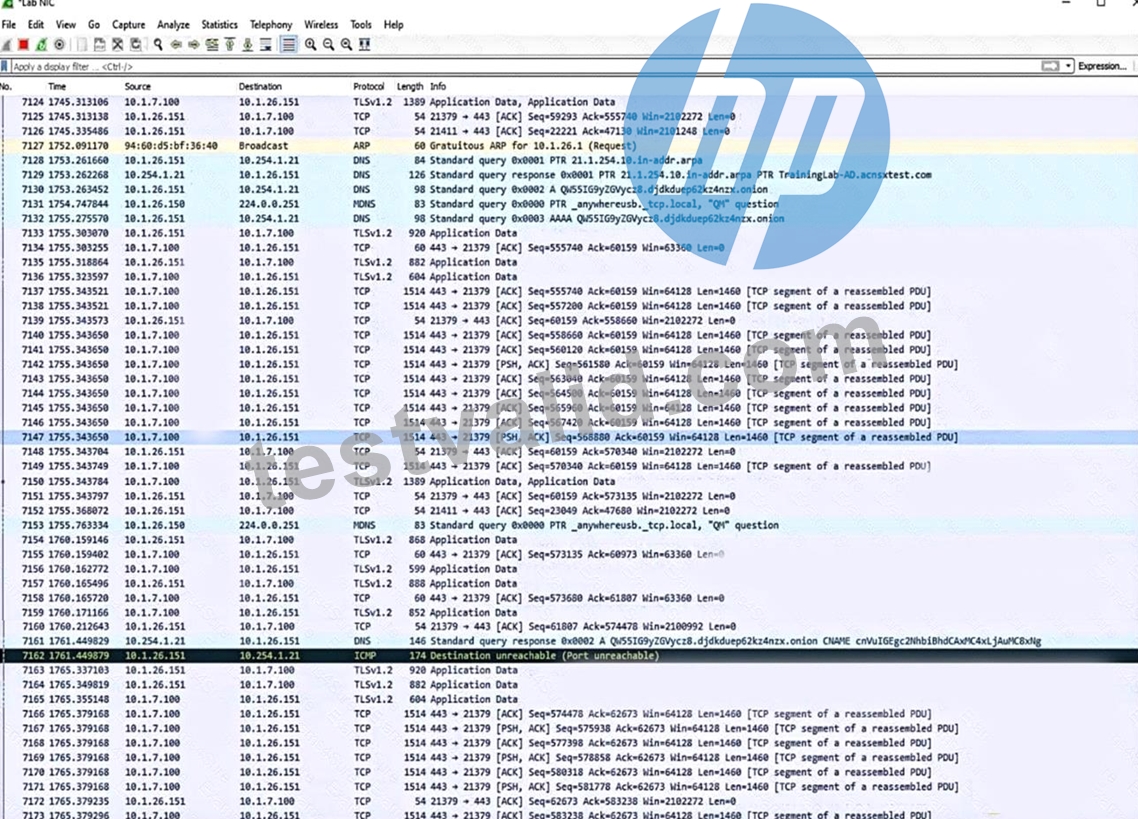
Which security issue is possibly indicated by this traffic capture?
- A. A port scan being run on the 10.1.7.0/24 subnet
- B. An attempt at a DoS attack by a device acting as an unauthorized DNS server
- C. A command and control channel established with DNS tunneling
- D. An ARP poisoning or man-in-the-middle attempt by the device at 94:60:d5:bf:36:40
Answer: C
Explanation:
Explanation
DNS tunneling is a technique that abuses the DNS protocol to tunnel data or commands between a compromised host and an attacker's server. DNS tunneling can be used to establish a command and control channel, which allows the attacker to remotely control the malware or exfiltrate data from the infected host1 The traffic capture in the exhibit shows some signs of DNS tunneling. The source IP address is 10.1.7.2, which is likely an internal host behind a firewall. The destination IP address is 8.8.8.8, which is a public DNS resolver. The DNS queries are for subdomains of badsite.com, which is likely a malicious domain registered by the attacker. The subdomains have long and random names, such as
0x2a0x2a0x2a0x2a0x2a0x2a0x2a0x2a.badsite.com, which could be used to encode data or commands. The DNS responses have large sizes, such as 512 bytes, which could be used to carry data or commands back to the host2
NEW QUESTION # 29
Refer to the exhibit.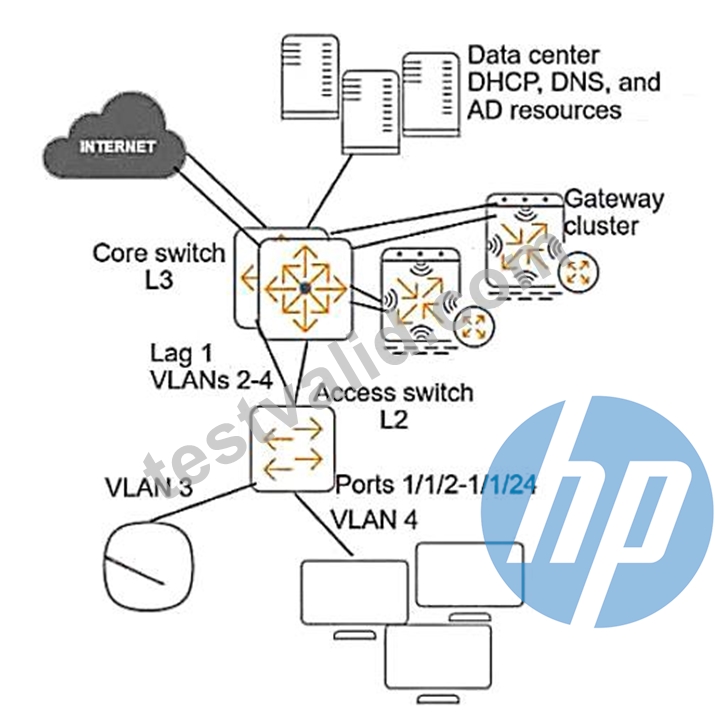
A customer requires protection against ARP poisoning in VLAN 4. Below are listed all settings for VLAN 4 and the VLAN 4 associated physical interfaces on the AOS-CX access layer switch:
What is one issue with this configuration?
- A. DHCP snooping is not enabled on VLAN 4.
- B. ARP proxy is not enabled on VLAN 4.
- C. Edge ports are not configured as untrusted for ARP inspection.
- D. LAG 1 is configured as trusted for ARP inspection but should be untrusted.
Answer: C
Explanation:
Explanation
This is because ARP inspection is a security feature that validates ARP packets in a network and prevents ARP poisoning attacks12 ARP inspection works by intercepting, logging, and discarding ARP packets with invalid IP-to-MAC address bindings1 To enable ARP inspection, the switch needs to know which ports are trusted and which are untrusted. Trusted ports are those that connect to authorized DHCP servers or other network devices that are not vulnerable to ARP spoofing. Untrusted ports are those that connect to end hosts or devices that might send forged ARP packets13 In the exhibit, LAG 1 is configured as a trusted port for ARP inspection, which is correct because it connects to the core switch. However, the edge ports (1/1/1-1/1/24) are not configured as untrusted ports for ARP inspection, which is incorrect because they connect to end hosts that might be compromised by an attacker. By default, all ports are untrusted for ARP inspection, but this can be changed by using the command ip arp inspection trust on the interface configuration mode3 Therefore, to protect VLAN 4 against ARP poisoning, the edge ports should be configured as untrusted for ARP inspection by using the command no ip arp inspection trust on the interface configuration mode. This way, the switch will validate the ARP packets received on these ports against the DHCP snooping database or an ARP access-list and drop any invalid packets34
A: ARP proxy is not enabled on VLAN 4. This is not an issue because ARP proxy is an optional feature that allows the switch to respond to ARP requests on behalf of hosts in different subnets5 It is not related to ARP poisoning or ARP inspection.
B: LAG 1 is configured as trusted for ARP inspection but should be untrusted. This is not an issue because LAG 1 connects to the core switch, which is a trusted device that does not send forged ARP packets.
C: DHCP snooping is not enabled on VLAN 4. This is not an issue because DHCP snooping is a separate feature that prevents rogue DHCP servers from offering IP addresses to clients6 It is not directly related to ARP poisoning or ARP inspection, although it can provide information for ARP inspection validation if enabled
NEW QUESTION # 30
Several AOS-CX switches are responding to SNMPv2 GET requests for the public community. The customer only permits SNMPv3. You have asked a network admin to fix this problem. The admin says, "I tried to remove the community, but the CLI output an error." What should you recommend to remediate the vulnerability and meet the customer's requirements?
- A. Adding an SNMP community with a long random name
- B. Enabling control plane policing to automatically drop SNMP GET requests
- C. Setting the snmp-server settings to "snmpv3-only"
- D. Enabling SNMPv3, which implicitly disables SNMPv1/v2
Answer: C
Explanation:
Explanation
This is because SNMPv3 is a secure version of SNMP that provides authentication, encryption, and access control for network management. SNMPv3-only is a configuration option on AOS-CX switches that disables SNMPv1 and SNMPv2c, which are insecure versions of SNMP that use plain text community strings for authentication. By setting the snmp-server settings to "snmpv3-only", the switch will only respond to SNMPv3 requests and reject any SNMPv1 or SNMPv2c requests, thus remedying the vulnerability and meeting the customer's requirements.
A: Enabling control plane policing to automatically drop SNMP GET requests. This is not a valid recommendation because control plane policing is a feature that protects the switch from denial-of-service (DoS) attacks by limiting the rate of traffic sent to the CPU. Control plane policing does not disable SNMPv1 or SNMPv2c, but rather applies a rate limit to all SNMP requests, regardless of the version. Moreover, control plane policing might also drop legitimate SNMP requests if they exceed the rate limit, which could affect the network management.
C: Adding an SNMP community with a long random name. This is not a valid recommendation because an SNMP community is a shared secret that acts as a password for accessing network devices using SNMPv1 or SNMPv2c. Adding an SNMP community with a long random name does not disable SNMPv1 or SNMPv2c, but rather creates another community string that can be used for authentication. Moreover, adding an SNMP community with a long random name does not improve the security of SNMPv1 or SNMPv2c, as the community string is still transmitted in plain text and can be intercepted by an attacker.
D: Enabling SNMPv3, which implicitly disables SNMPv1/v2. This is not a valid recommendation because enabling SNMPv3 does not implicitly disable SNMPv1 or SNMPv2c on AOS-CX switches. Enabling SNMPv3 only adds support for the secure version of SNMP, but does not remove support for the insecure versions. Therefore, enabling SNMPv3 alone does not remedy the vulnerability or meet the customer's requirements.
NEW QUESTION # 31
You are reviewing an endpoint entry in ClearPass Policy Manager (CPPM) Endpoints Repository.
What is a good sign that someone has been trying to gain unauthorized access to the network?
- A. The entry shows a profile conflict of having a new profile of Computer for a profiled Printer.
- B. The entry shows multiple DHCP options under the fingerprints.
- C. The entry shows an Unknown status.
- D. The entry lacks a hostname or includes a hostname with long seemingly random characters.
Answer: A
NEW QUESTION # 32
......
To prepare for the HP HPE6-A84 exam, you'll need to study network security concepts and techniques, as well as Aruba's network security solutions. You can find a variety of study resources online, including practice exams, study guides, and training courses. It's important to take the time to prepare for the exam thoroughly so that you can pass it on your first attempt.
Pass HP HPE6-A84 exam Dumps 100 Pass Guarantee With Latest Demo: https://pass4sure.testvalid.com/HPE6-A84-valid-exam-test.html