

Get Ready with HPE2-K45 Exam Dumps (2024)
Realistic HPE2-K45 Dumps are Available for Instant Access
HP HPE2-K45 exam is an important certification exam for IT professionals who want to validate their skills in using HPE SimpliVity. HPE SimpliVity is a hyperconverged infrastructure solution that provides a highly efficient and scalable platform for data center operations. HPE2-K45 exam focuses on testing the candidates' ability to design, deploy, manage, and troubleshoot HPE SimpliVity solutions.
NEW QUESTION # 14
A customer wants to migrate virtual machines from the existing infrastructure to HPE SimpiiVlty. How can
you complete this task?
- A. Share HPE SimpliVity datastores with standard ESXi hosts, and migrate the virtual machines.
- B. Add ESXi system to the HPE SimpliVity cluster, and migrate the virtual machines to HPE SimpliVity datastores.
- C. Map VMFS datastores holding the virtual machine files as an RDM to HPE SimpliVity nodes, and
migrate the virtual machines. - D. Connect VMFS datastores holding the virtual machine files to HPE SimpliVity nodes, and migrate the
virtual machines.
Answer: B
NEW QUESTION # 15
What does HPE Reference Architectures for HPE Simplicity provide?
- A. validated configuration for a specific workload
- B. comparison with equivalent competitor offerings
- C. recommended hardware configuration in ne Config Advanced (CA) format
- D. solution pricing and possible discounts
Answer: A
NEW QUESTION # 16
What happens if an HPE mniStack Virtual Controller (VC) fails in a multi-node HPE SimpliVrty cluster?
- A. All VMs on the node go on standby mode to avoid data loss.
- B. HPE SimpliVity Intelligent Workload ptimizer restores the VC from backups.
- C. The IP address of the VC fails over to another HPE SimpliVity node.
- D. All VMs on the node restart in a node where the replica resides.
Answer: D
NEW QUESTION # 17
In an HPE SimpliVity 10-node cluster, a simultaneous increase of 10 requests across several VM caused a surge in 10 traffic in a single node. Which HPE SimpliVity feature can evenly distribute the 10s across the cluster?
- A. Management Virtual Appliance
- B. Arbiter
- C. Intelligent Workload optimizer
- D. Resource Balancer
Answer: C
Explanation:
The Intelligent Workload Optimizer is a feature of HPE SimpliVity that automatically balances the virtual machine workloads across the nodes in a cluster, based on the CPU, memory, and storage utilization1. This feature helps to improve the performance and efficiency of the cluster, and to avoid hotspots and bottlenecks. The Intelligent Workload Optimizer can be configured to run periodically or on demand, and it can also take into account the affinity and anti-affinity rules for the virtual machines2. The Resource Balancer (option A) is a feature of HPE SimpliVity that automatically balances the storage capacity across the nodes in a cluster, based on the free space and deduplication ratio3. This feature helps to optimize the storage utilization and availability of the cluster, and to avoid capacity issues and data loss. The Resource Balancer does not balance the virtual machine workloads or the I/O traffic. The Management Virtual Appliance (option B) is a component of HPE SimpliVity that provides the management interface and functionality for the cluster, such as backup, restore, clone, move, and federation operations4. The Management Virtual Appliance does not balance the virtual machine workloads or the I/O traffic. The Arbiter (option C) is a component of HPE SimpliVity that provides the quorum service for the cluster, ensuring data consistency and availability in the event of a node or site failure5. The Arbiter does not balance the virtual machine workloads or the I/O traffic.
References:
1: Using HPE SimpliVity Official Certification Study Guide (HPE2-K45), HPE Press, 2019, p. 83.
2: HPE SimpliVity 380 Gen10 Node Data sheet, HPE, 2019, p. 4.
3: Using HPE SimpliVity Official Certification Study Guide (HPE2-K45), HPE Press, 2019, p. 84.
4: Using HPE SimpliVity Official Certification Study Guide (HPE2-K45), HPE Press, 2019, p. 81.
5: Using HPE SimpliVity Official Certification Study Guide (HPE2-K45), HPE Press, 2019, p. 82.
NEW QUESTION # 18
You want to use the HPE SimpliVity move operation to move a virtual machine between clusters. What do
you have to do prior to completing the move operation?
- A. Take a virtual machine snapshot.
- B. Shut down the virtual machine.
- C. Install VS5 agent in the virtual machine.
- D. Suspend the virtual machine.
Answer: C
NEW QUESTION # 19
A customer wants to provide access to the HPE SimpliVity datastores for compute nodes running
CPU-intensive virtual machines. What should you tell the customer?
- A. Connecting ESXi compute nodes is possible only when VMFS datastores are configured at SimpliVity
Federation level - B. Compute nodes must reside in the same cluster as HPE SimpliVity nodes.
- C. It is supported to connect up to 5 compute nodes per SimpliVity node.
- D. Additional license is required to connect ESXi nodes to SimpliVity datastores.
Answer: D
NEW QUESTION # 20
What can be configured using HPE Storence Management Console?
- A. backup policy
- B. storage policy
- C. Catalyst store
- D. deduplication ratio
Answer: C
Explanation:
HPE Storence Management Console is a web-based management interface for HPE StoreOnce Systems, which are backup appliances that provide deduplication and replication capabilities. One of the features that can be configured using HPE Storence Management Console is the Catalyst store, which is a logical container for backup data that supports Catalyst protocol. Catalyst protocol is a proprietary protocol that enables source-side deduplication, low-bandwidth replication, and direct backup from application servers. Backup policy, storage policy, and deduplication ratio are not specific to HPE Storence Management Console, and can be configured using other tools or interfaces. References: HPE StoreOnce system software, section "Software Details". The StoreOnce System Management Console, section "The StoreOnce System GUI and CLI together make up the Management Console". HPE StoreOnce Catalyst User Guide, section "Introduction to HPE StoreOnce Catalyst".
NEW QUESTION # 21
A customer deleted a folder from a virtual machine running Windows. Click the backup option that you should
use to restore this folder.
Answer:
Explanation:
NEW QUESTION # 22
During the troubleshooting process, HPE Support requested a Support Capture file from multiple HPE
SimpliVity hosts. The customer is concerned about security and wants to know what is included in this file.
What information is included in this file? (Select two.)
- A. Security token to access system remotely
- B. License entitlement
- C. HPE InfoSight connection parameters
- D. Log files
- E. System status information
Answer: B,D
NEW QUESTION # 23
You try to delete an existing datastore, but the operation fails. What is a likely cause of the failure?
- A. The management network for a host is disconnected.
- B. The FC connection between the host and array has failed.
- C. This datastore is not added to your scope.
- D. The datastore is marked as read-only.
Answer: A
Explanation:
According to the HPE SimpliVity Video - How to Delete a HPE SimpliVity Datastore1, one of the possible causes of the failure to delete an existing datastore is that the management network for a host is disconnected.
This prevents the communication between the HPE SimpliVity federation and the vSphere Web Client, and thus the deletion operation cannot be performed. To check the management network status, the video suggests clicking Hosts from the vSphere Web Client inventory panel, double-clicking the host to check, clicking the Manage tab, and then the Networking subtab. The other options are not correct because:
The datastore being marked as read-only is not a likely cause of the failure to delete it. The HPE SimpliVity Administration Guide2 states that the datastore must be writable before deleting it, and that the HPE SimpliVity federation will automatically change the datastore to writable mode when deleting it.
The FC connection between the host and array failing is not a likely cause of the failure to delete the datastore. The HPE SimpliVity federation does not use FC connections to access the datastores, but rather uses NFS or SMB protocols over Ethernet networks2.
The datastore not being added to the scope is not a likely cause of the failure to delete it. The HPE SimpliVity federation does not require the datastore to be added to the scope to delete it, as long as the datastore is visible in the vSphere Web Client1. References: 1: HPE SimpliVity Video - How to Delete a HPE SimpliVity Datastore2: HPE SimpliVity Administration Guide (A00019350ENW), pages
105-107.
NEW QUESTION # 24
In an HPE SimpliVity 10-node cluster, a simultaneous increase of 10 requests across several VM caused a
surge in 10 traffic in a single node. Which HPE SimpliVity feature can evenly distribute the 10s across the
cluster?
- A. Management Virtual Appliance
- B. Resource Balancer
- C. Intelligent Workload optimizer
- D. Arbiter
Answer: D
NEW QUESTION # 25
Refer to exhibit: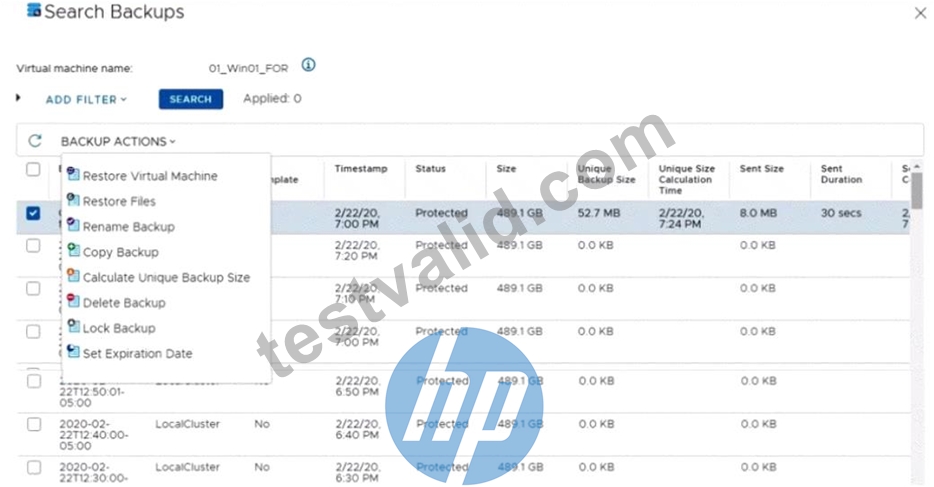
You are using Restore Virtual Machine for a given virtual machine. Which result is achieved by thrs operation?
- A. New snapshot added to existing virtual machine
- B. New virtual machine created out of this backup
- C. New linked-clone created
- D. Virtual machine boot partition mapped as IS image to another VM
Answer: C
NEW QUESTION # 26
Click the option that will allow you to integrate HPE SimpliVity with HPE Storence.
Answer:
Explanation:
Explanation:
Register External Store ...1
This option allows you to register an HPE StoreOnce Catalyst Store as an external backup target for HPE SimpliVity. This enables you to store VM backups on an HPEStoreOnce system, which is a disk-based backup solution that offers deduplication, compression, encryption, remote replication, and direct application-managed integration2.
To use this option, you need to have an HPE StoreOnce appliance connected to your HPE SimpliVity cluster, and configure a Catalyst Store on it. Then, you can select the All HPE SimpliVity Actions menu, and click Register External Store. You will be prompted to enter the following information:
The name of the external store
The IP address or hostname of the HPE StoreOnce appliance
The name of the Catalyst Store
The credentials of the Catalyst Store
After you enter the required information, click OK to register the external store1.
NEW QUESTION # 27
How is each datastore presented to HPE SimpliVity nodes?
- A. as a part of vSAN
- B. as an NFS datastore
- C. as a vVol
- D. as a VMFS datastore
Answer: D
NEW QUESTION # 28
A user deleted a file from Linux based virtual machine.
Which HPE SimpliVity data protection feature can be leveraged to recover the flie?
- A. Using file level restore option
- B. Reverting to the SimpliVity snapshot
- C. Restoring a virtual machine from the backup
- D. Moving a virtual machine from DR site to the primary site
Answer: A
Explanation:
According to the HPE SimpliVity Administration Guide1, the file level restore option allows you to recover individual files or folders from a backup of a virtual machine. Thisoption is useful when you need to restore a specific file that was accidentally deleted or corrupted, without affecting the rest of the virtual machine. The file level restore option supports both Windows and Linux based virtual machines, and can be performed using the HPE SimpliVity plugin in the vSphere Web Client. The file level restore option creates a temporary virtual machine from the backup, mounts the virtual disks, and copies the selected files or folders to a destination of your choice. The temporary virtual machine is then deleted automatically.
The other options are not suitable for recovering a single file from a Linux based virtual machine. Restoring a virtual machine from the backup would overwrite the entire virtual machine with the backup data, which may not be desirable or necessary. Moving a virtual machine from DR site to the primary site would not help if the file was deleted from both sites. Reverting to the SimpliVity snapshot would also overwrite the entire virtual machine with the snapshot data, which may not be the latest or the most relevant version. References:
1: HPE SimpliVity Administration Guide,
https://support.hpe.com/hpesc/public/docDisplay?docId=sf000062138en_us&docLocale=en_US, page
76-78
NEW QUESTION # 29
A customer plans to mix nodes with different drive configuration in the same cluster. What should you explain to this customer?
- A. Mixing All-flash and hybrid nodes in the same cluster is supported.
- B. Mixing different drive configurations within a cluster results in unbalanced 10 performance.
- C. Mixing nodes with different drive configuration is available only for AMD-based nodes.
- D. Mixing nodes with different drive configuration requires an additional license.
Answer: B
Explanation:
According to the HPE SimpliVity documents and learning resources, mixing nodes with different drive configurations within a cluster is not recommended, as it can result in unbalanced 10 performance and capacity utilization. This is because the HPE SimpliVity nodes use a distributed file system that replicates data across all nodes in the cluster, and the data efficiency and backup features depend on the consistent performance of the underlying storage devices. Therefore, it is best to use nodes with the same drive configuration and capacity within a cluster, and avoid mixing All-flash and hybrid nodes, or nodes with different drive types, sizes, or speeds. The other options are incorrect because they are either false or irrelevant. Mixing nodes with different drive configuration does not require an additional license, nor is it available only for AMD-based nodes. Mixing All-flash and hybrid nodes in the same cluster is not supported, as it can causeperformance and capacity issues. References: Using HPE SimpliVity Official Certification Study Guide, page 42; HPE SimpliVity networking explained; HPE SimpliVity Releases
NEW QUESTION # 30
A customer is planning to deploy VDI infrastructure on HPE SimpuVity platform. They are considering implementing stretched cluster. Which statement regarding the design of a stretched cluster is true?
- A. An Arbiter should be placed in a primary site and replicated to the secondary site.
- B. Stretched clusters need additional licenses for VDI workloads,
- C. Both Linked clones and Full clones are supported on a stretched cluster.
- D. Stretched clusters support up to 96 HPE SimpliVity hosts.
Answer: C
Explanation:
A stretched cluster is a configuration that allows two or more HPE SimpliVity clusters to span across different physical locations, while maintaining a single logical cluster and asingle management interface. A stretched cluster provides high availability, disaster recovery, and workload mobility for the virtual machines (VMs) running on the HPE SimpliVity platform12.
A VDI infrastructure is a virtualization solution that delivers desktops and applications to end users from a centralized data center. VDI infrastructure can use different types of VMs, such as linked clones or full clones, to provide the desktops and applications to the end users. Linked clones are VMs that share a common base image and consume less storage space, while full clones are VMs that have their own independent copies of the base image and consume more storage space34.
According to the HPE Reference Architecture for VMware Horizon on HPE SimpliVity document, both linked clones and full clones are supported on a stretched cluster. The document states that "HPE SimpliVity supports both linked clones and full clones on a stretched cluster. Linked clones are recommended for better storage efficiency and performance. Full clones can be used for persistent desktops that require more customization and personalization."5 The document also provides the design considerations and best practices for deploying VDI infrastructure on HPE SimpliVity stretched cluster, such as the network requirements, the VM placement, the backup and restore policies, and the failover and failback scenarios.
References:
1: HPE SimpliVity Stretched Cluster Guide 2: HPE SimpliVity Stretched Cluster 3: What is VDI (Virtual Desktop Infrastructure)? - VMware 4: What is a Linked Clone? - Definition from Techopedia 5: HPE Reference Architecture for VMware Horizon on HPE SimpliVity : [HPE SimpliVity Data Virtualization Platform] : [HPE SimpliVity Intelligent Workload Optimizer] : [HPE SimpliVity Federation Design and Scaling Guide]
NEW QUESTION # 31
Which criteria does HPE SimpliVity use to decide how many streams it needs to copy data to an HPE Storence
target?
- A. VM size
- B. available bandwidth
- C. latency requirements
- D. datastore size
Answer: A
NEW QUESTION # 32
A customer plans to add HPE SimpliVity 380 Gen10 H SFF nodes to their remote site. The primary site is running HPE SimpliVity 380 Gen10 hardware accelerated nodes. Which recommendation should be applied for this design?
- A. Configure the HPE SimpliVity 380 Gen 10 H SFF with a hardware accelerator card.
- B. Create a new cluster and split Doth types of nodes equally between both clusters,
- C. Add new nodes to the existing cluster
- D. Create a new cluster with SimpliVity 380 Gen10 H SFF nodes.
Answer: D
Explanation:
According to the HPE SimpliVity documents and learning resources, the best practice for designing an HPE SimpliVity solution is to use nodes with the same drive configuration and capacity within a cluster, and avoid mixing All-flash and hybrid nodes, or nodes with different drive types, sizes, or speeds. This is because mixing nodes with different drive configurations can result in unbalanced 10 performance and capacity utilization, as well as compatibility issues.Therefore, the recommended option for this design is to create a new cluster with HPE SimpliVity 380 Gen10 H SFF nodes at the remote site, and keep the existing cluster with HPE SimpliVity 380 Gen10 hardware accelerated nodes at the primary site. The other options are incorrect because they do not follow the best practice and can cause performance and capacity problems. References: Using HPE SimpliVity Official Certification Study Guide, page 42; HPE SimpliVity networking explained; HPE SimpliVity Releases
NEW QUESTION # 33
A customer plans to deploy HPE SimpliVity 380 Gen10 LFF H and HPE SimpliVity 380 Gen10 SFF H nodes.
What should you recommend tor this setup?
- A. Put SFF and LFF nodes in separate clusters.
- B. Put each type of the nodes in a different federation.
- C. Put all of the nodes in the same cluster.
- D. Replace the LFF nodes with all-flash nodes.
Answer: A
NEW QUESTION # 34
What is the difference between crash consistent and application consistent cloning methods?
- A. Crash consistent method should be used only for the virtual machines with Fault Tolerance enabled.
- B. Both methods are the same; the only difference is speed of cloning.
- C. Application-consistent clones allow the pending 10 operations to finish before committing them to the
database. - D. Application consistent method is available only for Linux operating systems.
Answer: C
NEW QUESTION # 35
You are designing an HPE SimpliVity solution with HPE Storence.
Which design aspects will you evaluate to optimize replication performance?
- A. Intelligent Workload optimizer settings
- B. Number of the HPE SimpliVlty clusters and Catalyst stores used
- C. Performance optimization features provided by VMFS datastores comapred to NFS datastores
- D. HPE SimpliVity model used
Answer: C
NEW QUESTION # 36
A customer wants to deploy HPE SimpliVity for a VDI Implementation. They need to add two NVIDIA GPU
accelerators per hypervisor, and they have limited space in the data center. Which HPE SimpliVity model
meets the customer needs?
- A. HPE SimpliVity 380 Ge10G
- B. HPE SimpliVity 325 Gen10
- C. HPE SimpliVity 2600
- D. HPE SimpliVity 380 Gen 10 LFF H
Answer: B
NEW QUESTION # 37
A customer has development virtual machines that do not require storage HA. How can the customer save storage capacity within an HPE SimpliVity cluster?
- A. By disabling the HA feature for only these virtual machines at vCenter Server
- B. By placing them on HPE Storence instead of HPE SimpliVity
- C. By creating a single-replica datastore for these virtual machines
- D. By disabling HA cluster functionality for HPE SimpliVity Federation
Answer: C
Explanation:
HPE SimpliVity provides storage HA by creating two copies of each virtual machine data across different nodes in a cluster. This ensures that the virtual machines can continue to run even if one node fails. However, this also consumes twice the storage capacity for each virtual machine. For development virtual machines that do not require storage HA, the customer can save storage capacity by creating a single-replica datastore for these virtual machines. A single-replica datastore is a datastore that has only one copy of the virtual machine data on one node. This reduces the storage consumption by 50%, but also increases the risk of data loss and unavailability in case of node failure. Therefore, the customer should carefully weigh the trade-offs between storage efficiency and data protection when using a single-replica datastore. References: HPE SimpliVity Data Virtualization Platform; HPE SimpliVity User Guide
NEW QUESTION # 38
A customer plans to add HPE SimpliVity 380 Gen10 H SFF nodes to their remote site. The primary site is
running HPE SimpliVity 380 Gen10 hardware accelerated nodes. Which recommendation should be applied
for this design?
- A. Create a new cluster and split Doth types of nodes equally between both clusters,
- B. Create a new cluster with SimpliVity 380 Gen10 H SFF nodes.
- C. Add new nodes to the existing cluster
- D. Configure the HPE SimpliVity 380 Gen 10 H SFF with a hardware accelerator card.
Answer: D
NEW QUESTION # 39
......
HP HPE2-K45 Exam Syllabus Topics:
| Topic | Details |
|---|---|
| Topic 1 |
|
| Topic 2 |
|
| Topic 3 |
|
| Topic 4 |
|
| Topic 5 |
|
| Topic 6 |
|
| Topic 7 |
|
HP HPE2-K45 exam is an essential certification for IT professionals who use HPE SimpliVity solutions in their work. It tests their knowledge and skills in a range of areas and provides them with numerous benefits, including increased career opportunities, higher earning potential, and greater recognition as experts in the field.
Download Exam HPE2-K45 Practice Test Questions with 100% Verified Answers: https://pass4sure.testvalid.com/HPE2-K45-valid-exam-test.html