

Best JN0-363 Exam Dumps for the Preparation of Latest Exam Questions
JN0-363 Actual Questions 100% Same Braindumps with Actual Exam!
NEW QUESTION # 21
You are deploying an MC-LAG connection at the edge of your network to a new customer. This solution must ensure that traffic uses all available links when forwarding traffic between the two networks.
In this scenario, which two statements are correct? (Choose two.)
- A. You must use active/active mode when defining the MC-LAG bundle.
- B. Transit traffic sent between the two PE devices will use the bundle's member interfaces.
- C. You must use active/standby mode when defining the MC-LAG bundle.
- D. Transit traffic sent between the two PE devices will use the ICL interface.
Answer: A,D
NEW QUESTION # 22
Which new field is added to an IPv6 header as compared lo IPv4?
- A. fragment offset
- B. version
- C. flow label
- D. checksum
Answer: C
Explanation:
The IPv6 header includes a new field that is not found in the IPv4 header, called the flow label. The flow label in IPv6 is used to identify packets that require special handling by routers for quality of service (QoS) or other reasons, allowing these packets to be handled efficiently as they move through the network.
Reference:
Juniper Networks Technical Documentation on IPv6
IPv6 Header Fields - Juniper Networks
NEW QUESTION # 23
Click the Exhibit button.
Referring to the exhibit, which statement is correct?
- A. R4 will be the designated router
- B. R1 will not participate in the election process
- C. R2 will be the designated router
- D. R3 will not participate in the election process
Answer: D
Explanation:
https://www.juniper.net/documentation/en_US/junos/topics/topic-map/configuring-ospf-areas.html#id-example-controlling-ospf-designated-router-election
NEW QUESTION # 24
You are asked to create connections between routing instances on the same Junos device and route between the connected Instances. What are two ways to accomplish this task? (Choose two.)
- A. Use physical interfaces.
- B. Use loopback interfaces.
- C. Use logical tunnel interfaces.
- D. Use an IRB interface.
Answer: A,C
NEW QUESTION # 25
Exhibit
You configured interface ge-0/070.0 to run IS-IS. but this interface does not appear in the output of the show isis adjacency command as shown in the exhibit.
What is the problem in this scenario?
- A. The router at the other end of the link Is not sending any IS-IS Hello messages.
- B. The family iso statement must be added to the logical interface.
- C. The router at the other end of the link is a Level 1 only router.
- D. This is a Gigabit Ethernet interface, that is incompatible with the reference-bandwidth 100g statement.
Answer: B
Explanation:
For IS-IS to form adjacencies, the 'family iso' statement must be configured on the interface. This is required because IS-IS operates over the connectionless network service (CLNS) and not over IP. Without the 'family iso' configuration, IS-IS cannot form adjacencies over the interface.
References:
Juniper Networks documentation on IS-IS: IS-IS User Guide for Routing Devices
NEW QUESTION # 26
Click the Exhibit button.
Referring to the exhibit, which statement is correct?
- A. R1 is an ABR
- B. R2 is an ASBR
- C. R1 is a backbone router
- D. R2 is an ABR
Answer: D
NEW QUESTION # 27
Exhibit
Referring to the exhibit, what must be included in the Route1 configuration when establishing an EBGP session with the ISP?
- A. The BGP session type external must be specified.
- B. A local address must be specified.
- C. The BGP session type internal must be specified.
- D. A local AS must be specified.
Answer: B
NEW QUESTION # 28
Exhibit
You have configured graceful RE switchover (GRES), however you cannot complete the show system switchover command.
Referring to the exhibit, what is the problem?
- A. The command is only available If graceful restart is enabled.
- B. The command is only available on the backup Routing Engine.
- C. The command is only available if non-stop routing is enabled.
- D. The command is only available If a backup router is configured.
Answer: B
NEW QUESTION # 29
Exhibit
The routers shown in the exhibit ate configured for segment routing.
In this scenario, what is the adjacency SIO that Router B advertises to Router A?
- A. 0
- B. 10.1.1.2
- C. 1
- D. 10.1.1.1
Answer: A
Explanation:
The adjacency SID in segment routing is advertised by one router to inform another about the label that should be used to forward traffic to it over a particular link. In this scenario, Router B would advertise an adjacency SID to Router A, which would be used by Router A to forward traffic to Router B. Based on the exhibit, the adjacency SID that Router B advertises to Router A would be 12.
Reference:
Juniper Networks documentation on Segment Routing: Segment Routing Overview
NEW QUESTION # 30
Which two statements ate correct about the BGP next-hop attribute value? (Choose two.)
- A. By default, the next-hop value is not changed across EBGP links.
- B. By default, the next-hop value is changed across EBGP links.
- C. By default, the next-hop value is not changed across IBGP links.
- D. By default, the next-hop value is changed across IBGP links.
Answer: D
NEW QUESTION # 31
What are two benefits of using an OSPF designated router (DR)? (Choose two.)
- A. Reduces the size of the link-state database.
- B. Reduces LSA flooding throughout an OSPF area.
- C. Reduces router resources used.
- D. Reduces LSA flooding on a broadcast segment.
Answer: C,D
NEW QUESTION # 32
What are three types of MPLS routers? (Choose three.)
- A. peering routers
- B. egress routers
- C. aggregation routers
- D. transit routers
- E. ingress routers
Answer: B,D,E
Explanation:
https://www.juniper.net/documentation/us/en/software/junos/mpls/topics/topic-map/lsp-routers.html In an MPLS network, the types of routers include ingress routers (where the MPLS labels are first applied), egress routers (where MPLS labels are removed), and transit routers (which switch MPLS-labeled packets through the MPLS network). Peering routers and aggregation routers are not specific types of MPLS routers; they are general network terms.
Reference:
Juniper Networks documentation on MPLS: MPLS Fundamentals
NEW QUESTION # 33
Interface ge-0/0/0.0 connects your network to your ISP. You want to advertise this interface address as an Internal route In OSPF without creating a neighbor with your ISP.
In this scenario, how is this task accomplished?
- A. Add ge-0/0/0.0 as a passive interface In OSPF.
- B. Create a generated route for Interface ge-0/0/0.0.
- C. Remove interface ge-0/0/0.0 from OSPF.
- D. Configure a static route for Interface ge-0/0/0.0.
Answer: A
NEW QUESTION # 34
Exhibit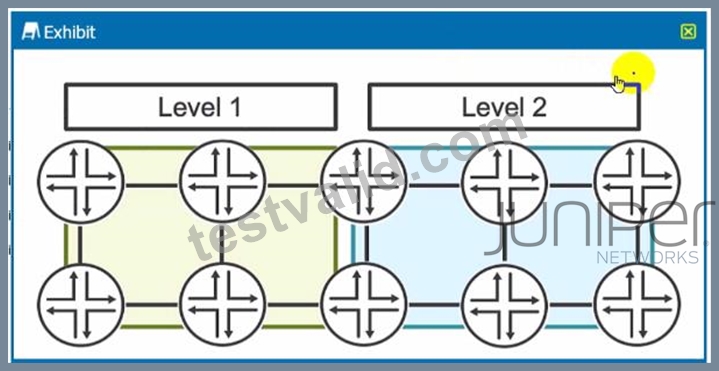
Referring to the exhibit, which two statements are correct? (Choose two.)
- A. Prefixes in Level 1 will not be redistributed to Level 2.
- B. Prefixes in Level 2 will be redistributed to Level 1.
- C. Prefixes in Level 2 will be not redistributed to Level 1.
- D. Prefixes in Level 1 will be redistributed to Level 2.
Answer: C,D
Explanation:
By default, IS-IS protocol leaks routing information from a Level 1 area to a Level 2 area. However, to leak routing information from a Level 2 area to a Level 1 area, an export policy must be explicitly configured.
NEW QUESTION # 35
Routers R1 and R4 have a VRRP priority of 90, while R2 and R3 have default VRRP priorities Referring to the exhibit, which router will be elected as the primary VRRP router?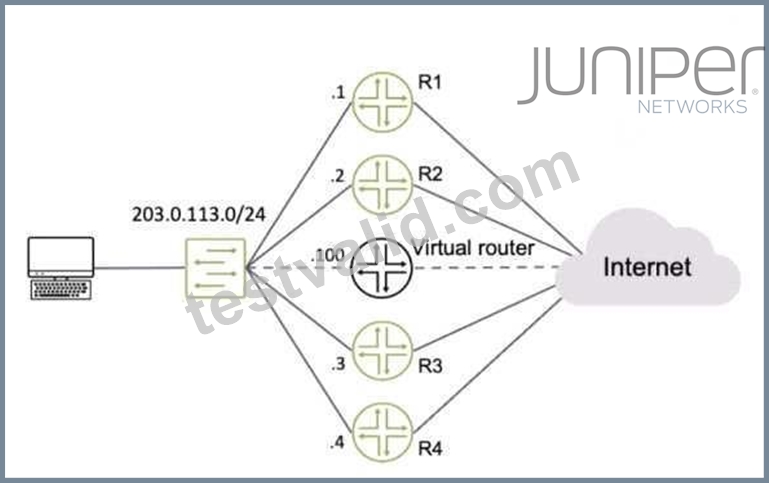
- A. R4
- B. R3
- C. R1
- D. R2
Answer: C
NEW QUESTION # 36
What are two characteristics of a traditional Ethernet LAN? (Choose two.)
- A. Nodes use a step-up algorithm when collisions are detected.
- B. Nodes can successfully transmit simultaneously.
- C. It consists of a single broadcast domain.
- D. Nodes share a physical medium.
Answer: C,D
NEW QUESTION # 37
By default, which two statements are correct about switch ports on a Junos device? (Choose two.)
- A. Access ports receive and transmit tagged traffic.
- B. Access ports receive and transmit untagged traffic.
- C. Trunk ports receive and transmit tagged traffic.
- D. Trunk ports receive and transmit untagged traffic.
Answer: B,C
Explanation:
On a Junos device, trunk ports are configured to receive and transmit tagged traffic only, while access ports are configured to receive and transmit untagged traffic.
Reference::
Understanding Access and Trunk Interfaces, Juniper Networks Documentation VLANs and Trunking, Juniper Networks Documentation
NEW QUESTION # 38
The LSP is not establishing correctly.
Referring to the exhibit, what should you do to solve the problem?
- A. Enable traffic engineering for the BGP protocol.
- B. Enable traffic engineering for the RSVP protocol.
- C. Enable traffic engineering for the OSPF protocol.
- D. Enable traffic engineering for the IS-IS protocol.
Answer: B
NEW QUESTION # 39
......
JN0-363 Study Material, Preparation Guide and PDF Download: https://pass4sure.testvalid.com/JN0-363-valid-exam-test.html