

Achieve the NCP-EUC Exam Best Results with Help from Nutanix Certified Experts
Provide NCP-EUC Practice Test Engine for Preparation
The NCP-EUC certification is widely recognized by employers and is highly valued in the industry. It is an excellent way for professionals to demonstrate their skills and knowledge and to advance their careers in the field of end-user computing. Nutanix Certified Professional - End - User Computing certification is also an excellent way for organizations to ensure that their employees have the skills and knowledge necessary to deliver and manage end-user computing solutions using Nutanix technology.
NEW QUESTION # 47
An administrator received a report that users are being disconnected from their sessions consistently after IO minutes. The administrator suspects the gold image is incorrectly configured, Which action should the administrator take to resolve this issue?
- A. Disable the monitor power saving settings.
- B. Uninstall and remove the Windows Store applications.
- C. Sysprep the gold image with the CopyProfile set to True.
- D. Disable hard drive power saving settings.
Answer: C
Explanation:
gold image is a term used to describe a template for a virtual machine (VM) that contains a preconfigured operating system and applications1. A gold image can be used to create multiple session hosts that share the same configuration1. However, a gold image needs to be properly prepared before being used as a template12
3.
One of the steps involved in preparing a gold image is to run sysprep on the VM. Sysprep is a tool that removes system-specific data such as computer name, security identifier (SID), and driver cache from Windows23. This allows the VM to be generalized and duplicated without causing conflicts or errors23.
One of the options that can be set when running sysprep is CopyProfile. CopyProfile is a setting that determines whether the user profile settings of the built-in administrator account are copied to the default user profile2. The default user profile is used as a template for creating new user profiles on Windows2. If CopyProfile is set to True, then any changes made by the administrator account (such as desktop wallpaper, screen saver, Start menu items, etc.) will be applied to all new user profiles2.
Therefore, if users are being disconnected from their sessions consistently after 10 minutes, it could be because the gold image has some incorrect settings in the default user profile that cause session timeout or termination. To resolve this issue, one possible solution is to sysprep the gold image with CopyProfile set to True, and make sure that there are no settings in the administrator account that could affect session stability (such as power saving options or Windows Store applications)2.
NEW QUESTION # 48
An administrator has created a Prism Central Playbook Action named Virtual Desktop Add CPU to add 2 vCPU to virtual desktop when an alert is triggered after the virtual desktop's CPU usage has exceeded 80%.
Initially the Playbook Action works as expected, however over time it seems it is no longer being triggered.
What is causing this issue?
- A. There are no more CPUs availed to allocate to the VM.
- B. The virtual desktop CPU Usage alerts were not cleared.
- C. The vNUMA boundary has been breached preventing more vCPUs to be added.
- D. Additional vCPUs need to be registered.
Answer: B
Explanation:
https://next.nutanix.com/community-blog-154/new-x-play-actions-in-prism-central-2021-7-40005 The Prism Central Playbook Action is a tool that allows you to automate tasks based on triggers, such as events, alerts, or webhooks. You can define a series of actions (called a playbook) that perform operations on your infrastructure, such as adding or reducing resources on a VM2.
To use the Playbook Action for VMs, you need to meet some prerequisites, such as:
The Prism Central version must be 2020.11 or later.
The AOS version must be 5.15 LTSR or later.
The hypervisor must be AHV or ESXi.
The VMs must have Nutanix Guest Tools (NGT) installed and enabled3.
One of the possible reasons why the Playbook Action is no longer being triggered is that the virtual desktop CPU Usage alerts were not cleared. According to the Prism Central guide3, "If an alert has been triggered once and has not been cleared yet, then it will not trigger any action again until it has been cleared". Therefore, if the CPU Usage alert remains active for a virtual desktop, it will prevent the Playbook Action from adding more vCPUs to it.
NEW QUESTION # 49
An administrator needs to configure a license server to be accessible by Frame desktops.
Which server should the administrator configure?
- A. utility Server
- B. Azure VM Instance
- C. EC2 VM Instance
- D. Sandbox
Answer: A
Explanation:
Frame is a cloud-based desktop-as-a-service platform that allows users to access Windows applications and desktops from any device1. A license server is a server that hosts a network licensing manager for software that requires licenses to run2. Frame supports using a utility server as a license server for Frame desktops1. A utility server is a stand-alone, general purpose Windows server that can be configured and managed from the Frame dashboard1.
https://docs.frame.nutanix.com/platform/admin/utility-servers/
NEW QUESTION # 50
An administrator is supporting two Nutanix Io-node AHV clusters (Cluster01 and Cluster02) dedicated for VDI workloads. The administrator has started receiving complaints regarding the performance of several full clone virtual desktops within Cluster01, upon review of both clusters, below are the discovered utilization metrics:
Cluster01 utilizations:
* Cluster CPU:85%
* Cluster Memory: 94%
* storage:50%
Cluster02 utilizations:
* Cluster CPU:30%
* Cluster Memory:35%
* storage:40%
Datacenter policy requires 20% resource overhead.
Which action should the administrator take to resolve this issue?
- A. Review the Hardware dashboard.
- B. use a Recovery Plan to migrate the virtual desktops.
- C. Use X-Ray to migrate the virtual desktops.
- D. Review the VM Overview dashboard.
Answer: B
Explanation:
administrator can take to resolve the issue of performance for several full clone virtual desktops within Cluster01 by migrating them to Cluster02.
a recovery plan is a set of steps that defines how to recover guest VMs from a disaster. A recovery plan can be used to migrate VMs between Nutanix clusters at the same or different availability zones1.
NEW QUESTION # 51
When creating a Frame account, which two are valid Network Type options? (Choose two.)
- A. Private Network
- B. Public Network
- C. Private Network with VPN
- D. Express Route
Answer: B,C
Explanation:
https://docs.frame.nutanix.com/platform/admin/account-creation/
The Public Network option provides access to the Frame environment over the public internet, while the Private Network with VPN option allows for a secure connection to the Frame environment over a private network using a VPN.
NEW QUESTION # 52
What are two primary purposes of a Frame utility Server? (Choose two.)
- A. shared file server
- B. Test and develop virtual desktops.
- C. Backend for a client-server application
- D. A server that monitors virtual desktop usage
Answer: A,C
Explanation:
Frame utility server is a stand-alone, general purpose Windows server that can be helpful for a variety of use cases, including:
License server: Install a network licensing manager for your software on a Frame utility server. Your production instances can then connect to this server to get the licenses.
Backend for a client-server application: Install a database or other backend service on a Frame utility server. Your production instances can then connect to this server to run your client-server application.
Shared file server: Install a file sharing service on a Frame utility server. Your production instances can then access shared files from this server.
Test and develop virtual desktops: Use a Frame utility server as a sandbox environment to test and develop your virtual desktops before publishing them to your production account.
https://docs.frame.nutanix.com/platform/admin/utility-servers/
NEW QUESTION # 53
An administrator has been evaluating a performance issue with the current Citrix VD' solution on Nutanix. During the evaluation, the administrator finds out there is a feature that is enabled called Shadow Clones.
What would happen if an administrator disabled Shadow Clones within a company's VDI environment?
- A. Deployment times would increase as the number deployed desktops increase,
- B. Deployment times would decrease when deploying additional desktops.
- C. Boot storms would be eliminated because the number of desktops would be throttled.
- D. Boot storms would be eliminated due to desktop resource contention.
Answer: A
Explanation:
Nutanix's Shadow Clones feature is used to create linked clones or snapshots of base VMs, which can improve VM provisioning time and storage efficiency by reducing the amount of duplicated data.
If an administrator disables Shadow Clones within a company's VDI environment, it is likely that deployment times would increase as the number of deployed desktops increases. This is because linked clones or snapshots would no longer be used, so each new desktop deployment would require creating a full copy of the base VM.
Nutanix Shadow Clones allow for distributed caching of a particular disk or VM data, which are in a 'multi-reader' scenario. This can help in scenarios such as VDI or private clone boot storms, where VMs on multiple nodes read from the same set of base disks12
NEW QUESTION # 54
An administrator is trying to add a Nutanix cluster as a new connection, but connection name Nutanix AHV is not listed in the Connection type menu.
What should the administrator do to resolve this issue?
- A. Install the Nutanix AHV plugin for Citrix Director on Storefront Servers.
- B. Install the Nutanix AHV plugin for Citrix controllers.
- C. Install the Nutanix AHV plugin for Citrix Director on Delivery controllers.
- D. Install the Nutanix AHV plugin for Citrix on all Storefront.
Answer: B
Explanation:
This is because this option will enable the administrator to add a Nutanix cluster as a new connection by installing and registering the plugin on the Delivery Controllers that manage the connection type menu.
https://portal.nutanix.com/page/documents/solutions/details?targetId=BP-2079-Citrix-Virtual-Apps-and-Desktop
NEW QUESTION # 55
An administrator wants to deploy 1 ,OOO virtual desktops on Nutanix AOS and wants to leverage a cloning technology from the company's chosen virtual desktop broker vendor which is Citrix.
What kind of Nutanix storage efficiency feature should the administrator use for this solution?
- A. Compression + Deduplication
- B. Compression
- C. Deduplication
- D. Deduplication + Capacity
Answer: C
Explanation:
one of the possible Nutanix storage efficiency features that the administrator can use for this solution is Deduplication. Deduplication is a technology that eliminates duplicate blocks of data and reduces storage consumption. Deduplication can be enabled on a per-container basis and can provide significant savings for Citrix virtual desktop deployments that use cloning technologies such as Machine Creation Services (MCS) or Provisioning Services (PVS)1.
NEW QUESTION # 56
A multisite App Volumes deployment uses a stretched database over multiple Horizon View sites. Non-Attachable volumes will be used to support replication of AppStacks between blocks and pods.
What should the administrator do to be able to replicate AppStacks between the Nutanix clusters?
- A. storage container on the primary cluster to at least one host in other Nutanix clusters,
- B. Leverage an external storage system such as NFS NAS to support the non-attachable
- C. Utilize the native async disaster recovery technology to replicate the AppStacks between the Nutanix clusters.
- D. Replicate the .vmdk files and AppStacks permissions using a script between the Nutanix clusters,
Answer: C
Explanation:
regarding replicating AppStacks between Nutanix clusters, it is likely that the correct answer would involve configuring some form of replication or disaster recovery technology on the Nutanix clusters themselves.
https://portal.nutanix.com/page/documents/solutions/details?targetId=BP-2135-VMware-App-Volumes:BP-2135-VMware-App-Volumes
NEW QUESTION # 57
A previous administrator provisioned all of the virtual desktops in a virtual desktop Nutanix cluster using the following specifications:
* 6 vCPU
* 8 GB Memory
* 300 GB HDD
How can the current administrator best prepare next fiscal year's budget using Prism Central?
- A. Execute Capacity Runway scenario.
- B. Execute a Calm blueprint to add additional desktops.
- C. Review the most recent in Audits.
- D. Review most recent in Tasks.
Answer: A
Explanation:
In Nutanix Prism Central, the Capacity Runway scenario provides details on the available capacity for the next
12 months based on the current usage pattern. This feature can help the administrator to plan and prepare the budget for the next fiscal year. The administrator can use this information to decide whether more resources need to be added to the Nutanix cluster or if the existing resources are sufficient.
https://www.nutanix.com/products/prism/prism-central
Prism Central planning tools can help you estimate the capacity runway of your cluster by considering the storage, CPU, and memory capacity. However, you need to have at least 21 days of data from a cluster to calculate the baseline runway estimates4.
NEW QUESTION # 58
Users are being prompted to restart their non-persistent desktops in the middle of the day.
which setting in the gold image would cause this to occur?
- A. The power profile turns the screen off after 10 minutes.
- B. Windows Update policy is set to Automatic.
- C. The mandatory Windows profile is set to v4,
- D. Java automatically checks for updates every' 24 hours.
Answer: B
Explanation:
non-persistent VDI machines are deleted when they are rebooted, logged off, or shut down. Therefore, Windows Update policy should be configured to prevent automatic updates that may trigger a restart on these machines1.
https://techcommunity.microsoft.com/t5/microsoft-defender-for-endpoint/onboarding-and-servicing-non-persiste
NEW QUESTION # 59
What are the two types Of Launchpads that exist in Frame? (Choose two.)
- A. VDI Launchpad
- B. Desktop Launchpad
- C. Application Launchpad
- D. user Launchpad
Answer: B,C
Explanation:
There are two types of Launchpads that exist in Frame: Application Launchpad and Desktop Launchpad2.
An Application Launchpad is a representation of the applications that are available for streaming. Users can launch any application they have access to from this Launchpad. An example of an Application Launchpad is shown below:
A Desktop Launchpad is a representation of the desktops that are available for streaming. Users can launch any desktop they have access to from this Launchpad. An example of a Desktop Launchpad is shown below:
https://www.nutanix.com/blog/work-from-home-anywhere-in-five-easy-steps
NEW QUESTION # 60
A Windows IO VM fails to power on With an NVIDIA vCPU profile in ESXi 7. The VM is configured with NVIDIA profile by selecting Shared PCl Device, adding the NVIDIA GRID vCPU device. and selecting the Profile under VM settings.
The following error message is displayed in the vSphere web client: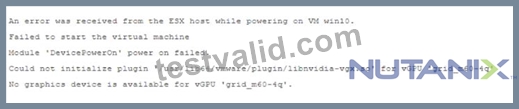
What should be done to resolve this issue?
- A. Switch the GPU mode to compute mode using gpumodeswitch command.
- B. change the Graphics mode of the host from Shared Direct to Shared.
- C. Switch the GPU mode to graphics mode using gpumodeswitch command.
- D. Change the Graphics mode of the host from Shared to Shared Direct
- E. Change the Graphics mode of the host from Shared to Shared Direct
Answer: C
Explanation:
gpumodeswitch is a command-line tool that is used to switch supported NVIDIA GPUs between compute and graphics mode. Compute mode allows multiple VMs to share a GPU for CUDA workloads. Graphics mode allows a single VM to use a GPU for graphics workloads12.
NEW QUESTION # 61
An administrator needs to manage the virtual desktop environment for a small QA group.
Which two requirements would prevent a non-persistent deployment? (Choose two.)
- A. users need to log on and log off frequently.
- B. users need to test application installation routines.
- C. users need to access web-based applications.
- D. users need to test various peripherals.
Answer: B,D
Explanation:
non-persistent VDI is a type of virtual desktop infrastructure (VDI) that does not save any changes made by the user on the virtual machine (VM) across sessions. Non-persistent VDI uses a master image to create and delete VMs as needed.
Therefore, if the administrator needs to manage a non-persistent deployment, they should avoid any requirements that involve modifying or installing applications on the VMs, as those changes would not be saved.
https://www.nutanix.com/support-services/training-certification/certifications/certification-details-nutanix-certifi
NEW QUESTION # 62
What are the two types Of Launchpads that exist in Frame? (Choose two.)
- A. VDI Launchpad
- B. Desktop Launchpad
- C. Application Launchpad
- D. user Launchpad
Answer: B,C
NEW QUESTION # 63
An administrator receives many complaints about increased boot times from a WI user over the past few days.
Upon further review, the administrator discovers delays in the deployments of VD' desktops. The administrator could not find any indications that the cluster resources are insufficient.
What should the administrator verify to resolve this issue?
- A. If Memory Overcommitment was disabled
- B. If a node failed
- C. If Shadow Clone was disabled
- D. Erasure Coding was disabled
Answer: C
Explanation:
Shadow Clones are a feature of the AOS storage that enables distributed caching of virtual disks (vDisks) that are read by multiple VMs on different nodes. This can improve performance and reduce network traffic in scenarios such as VDI deployments.
Therefore, if Shadow Clones were disabled, it could cause delays in the deployments of VD' desktops, as they would have to read the vDisk from a remote node instead of a local cache.
NEW QUESTION # 64
An administrator is migrating Citrix back-end infrastructure to Citrix Cloud.
What three pieces of information are needed to connect Prism to Citrix Cloud?
- A. Prism Data Service IP Address. Client ID, Passphrase
- B. Customer ID, Client ID. Secret Key
- C. Citrix Login, Secret Key, Passphrase
- D. Customer ID, Citrix Cloud Provider, Prism Data Service IP Address
Answer: B
Explanation:
https://docs.citrix.com/en-us/citrix-workspace/integrate.html
The Prism Citrix Cloud integration feature allows you to configure the Citrix Cloud settings in Prism Central and connect your Nutanix cluster as a resource location in Citrix Cloud4. This enables you to use Citrix Virtual Apps and Desktops service to deliver applications and desktops to your end users.
To use this feature, you need to meet some prerequisites, such as:
The Prism Central version must be 2020.11 or later.
The AOS version must be 5.15 LTSR or later.
The hypervisor must be AHV or ESXi.
You must have a valid Citrix Cloud account with access to Citrix Virtual Apps and Desktops service4.
One of the steps for configuring the Prism Citrix Cloud integration is to establish the connection to Citrix Cloud. To do this, you need to provide three pieces of information:
Customer ID: This is a unique identifier for your Citrix Cloud account that can be found in your profile settings2.
Client ID: This is a unique identifier for an API client that can access your Citrix Cloud account. You can create an API client in your identity and access management settings2.
Secret Key: This is a secret string that authenticates the API client. You can generate a secret key when you create an API client2.
NEW QUESTION # 65
An organization recently deployed an Active-passive VDI solution across multiple sites within their Nutanix platforms. The Organization is now on phase two of the project, which requires them to consolidate all user profile and home data, since each location will have its own standalone Microsoft File Server.
Which solution will provide a more easily-managed environment for profile and Home Share data that includes High Availability and a unified single namespace?
- A. Nutanix Storage Containers
- B. Microsoft DFS
- C. Microsoft FSLogix
- D. Nutanix Files
Answer: D
Explanation:
Nutanix Files is a software-defined, scale-out file storage solution that provides a repository for unstructured data, such as home directories, user profiles, departmental shares, application logs, backups, and archives1. Nutanix Files also provides high availability and a unified single namespace for easy management2.
NEW QUESTION # 66
Recently, the vice president Of IT infrastructure was migrated from a physical computer to a virtual desktop. The administrator wants to ensure that this user has the best possible experience and wants to be notified if any CPU resource constraints.
The cluster's average CPU utilization is 20%.
What step would help the administrator to know when there are resource problems on the virtual desktop?
- A. Create a new alert policy to alert if the CPU on the virtual desktop's cluster is over 90%.
- B. Create a new alert policy to alert if the CPU on the virtual desktop's host is over 90%.
- C. Create a new alert policy to alert if the CPU on the virtual desktop is over and configure a Playbook to power off the virtual desktop.
- D. Create a new alert policy to alert if the CPU on the virtual desktop is over and configure a Playbook to Slack the information to the administrator,
Answer: D
Explanation:
alert policies are rules that define the conditions for generating alerts on Nutanix clusters1. You can create custom alert policies based on your specific needs and preferences2Playbooks are automated workflows that perform actions based on triggers such as alerts3. You can create playbooks using predefined alerts or alerts matching criteria3.
To ensure that the vice president of IT infrastructure has the best possible experience and to be notified if any CPU resource constraints on the virtual desktop, one possible solution is to create a new alert policy to alert if the CPU on the virtual desktop is over a certain threshold (for example, 80%) and configure a playbook to send a notification (for example, via email or Slack) to the administrator23. This way, the administrator can monitor the performance of the virtual desktop and take appropriate actions if needed.
https://portal.nutanix.com/page/documents/details?targetId=Prism-Central-Guide-vpc_2022_6:mul-alert-policies-customize-system-pc-t.html
NEW QUESTION # 67
......
Detailed New NCP-EUC Exam Questions for Concept Clearance: https://pass4sure.testvalid.com/NCP-EUC-valid-exam-test.html